
Lesson 81: Refactoring the Auction Maintenance System for Cleaner, Maintainable Code

Objective
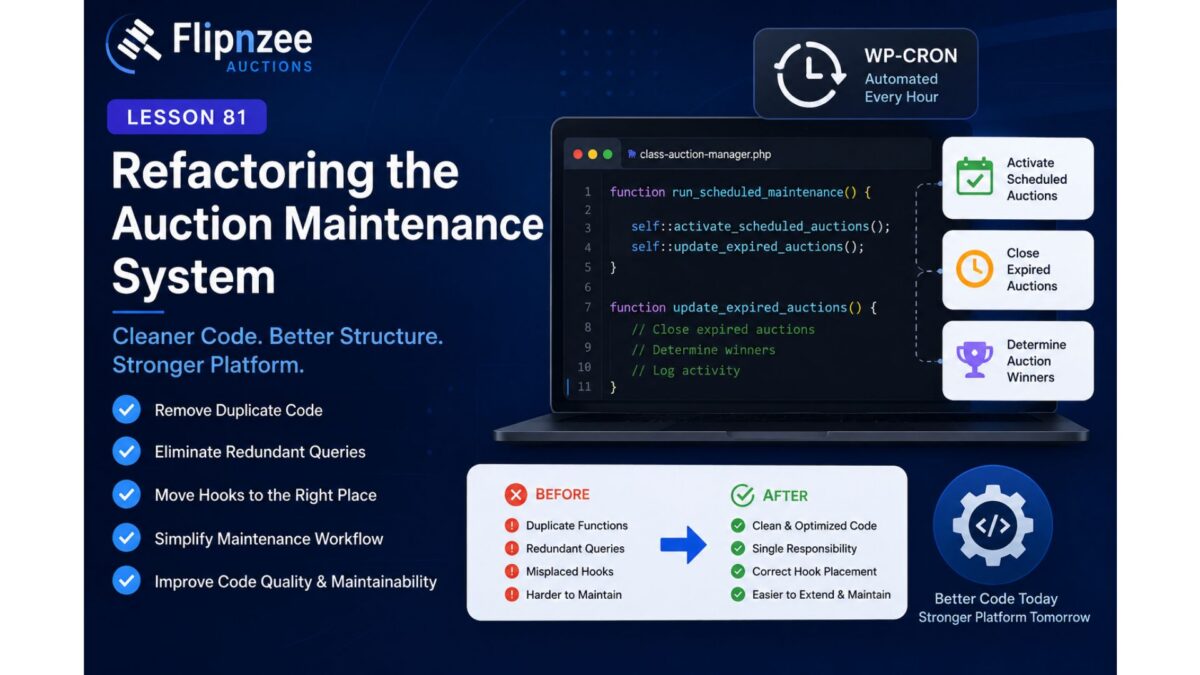
Refactor the auction maintenance system by removing duplicate code, eliminating redundant database queries, relocating hooks to their appropriate locations, and simplifying the auction lifecycle without changing any existing functionality.
Why This Lesson?
As the Flipnzee Auctions plugin has grown, some functionality has evolved through multiple iterations. This has resulted in duplicate methods and repeated SQL queries that can make future maintenance more difficult.
The goal of this lesson is not to add new features, but to improve the internal architecture while keeping the plugin’s behaviour unchanged.
Current Maintenance Flow
WP-Cron
    │
    ▼
run_scheduled_maintenance()
    │
    ├── activate_scheduled_auctions()
    │
    └── update_expired_auctions()
            │
            ├── Close auctions
            ├── Determine winners
            ├── Fire hooks
            └── Activity log
Problems Identified
Duplicate auction-closing methods
The plugin currently contains both:
update_expired_auctions()
and
close_expired_auctions()
Both perform nearly the same responsibility.
Only one should remain.
Duplicate SQL execution
Inside close_expired_auctions() the update query is executed twice.
This increases unnecessary database activity.
Hook placed in the wrong location
The following hook currently appears inside the auction manager:
do_action(
    'flipnzee_auction_winner_determined',
    $auction,
    $winner
);
However:
$auctionis not defined$winneris not defined
The hook belongs immediately after the winner has actually been determined inside the Bid Manager.
Misleading method
The method
get_active_auctions()
returns:
active
closed
instead of only:
active
The method name and behaviour should match.
Maintenance responsibilities
The auction manager should be responsible for:
- activating scheduled auctions
- closing expired auctions
- invoking winner determination
The Bid Manager should be responsible for:
- determining winners
- firing winner-related hooks
This keeps responsibilities separated and improves readability.
Implementation Plan
Step 1
Review the maintenance workflow.
Understand how:
- activation
- expiry
- winner determination
are connected.
Step 2
Remove duplicate SQL from:
close_expired_auctions()
Step 3
Decide which method to keep:
update_expired_auctions()close_expired_auctions()
Remove the redundant implementation.
Step 4
Move the winner hook into the Bid Manager.
After the winner has been determined:
do_action(
    'flipnzee_auction_winner_determined',
    $auction,
    $winner
);
should execute there.
Step 5
Simplify
run_scheduled_maintenance()
so that it remains the single entry point for scheduled auction processing.
Step 6
Correct
get_active_auctions()
so it returns only active auctions.
Step 7
Perform regression testing.
Verify:
- scheduled auctions activate
- expired auctions close
- winners are still determined
- transactions are still created
- activity logging still works
- payment workflow remains unaffected
Expected Result
After refactoring:
✔ No duplicate auction-closing methods
✔ No duplicate SQL execution
✔ Cleaner maintenance workflow
✔ Better separation of responsibilities
✔ Easier debugging
✔ Easier future enhancements
What We’ll Learn
During this lesson we’ll practice:
- code refactoring
- eliminating duplicate logic
- applying the Single Responsibility Principle
- organising WordPress plugin architecture
- improving long-term maintainability
Why This Matters
Refactoring is an important phase in any mature software project. By removing technical debt now, Flipnzee Auctions will have a cleaner foundation for future features such as:
- email notifications
- real-time auction updates
- advanced auction history
- seller dashboards
- buyer dashboards
- marketplace analytics
- REST API endpoints
- webhook integrations
Expected Outcome
By the end of Lesson 81, the auction maintenance system will be simpler, cleaner, and easier to extend, while preserving all existing functionality and improving the overall quality of the Flipnzee Auctions codebase.