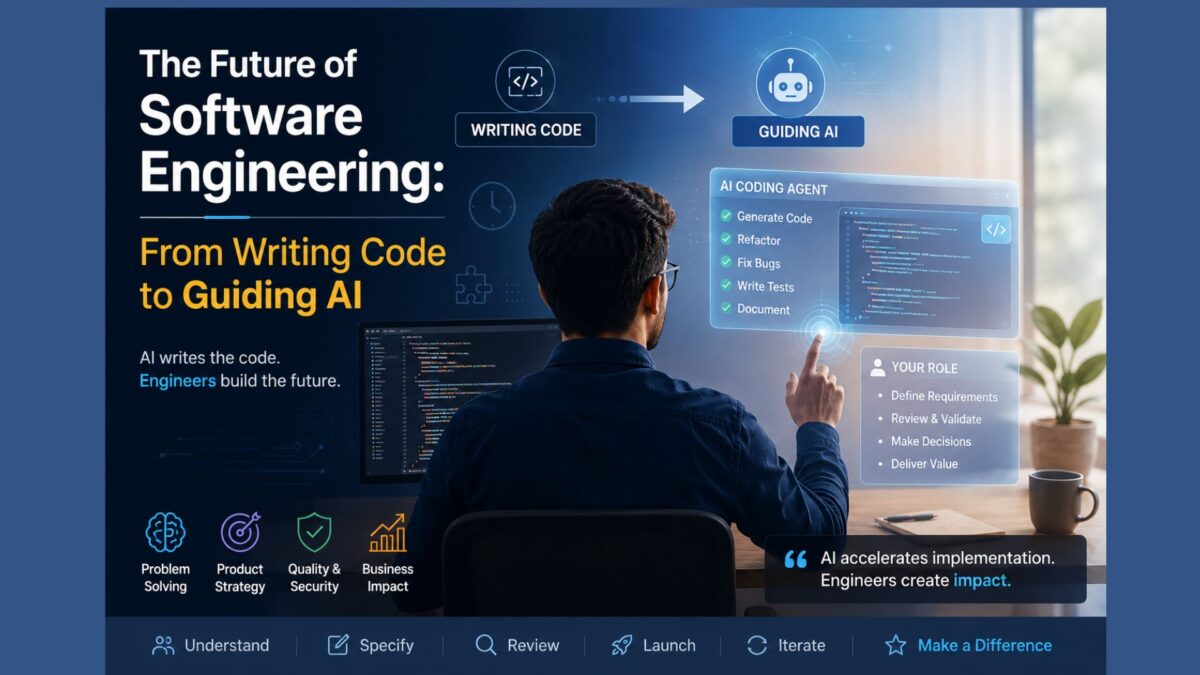
AI Coding Agents Didn’t Make Software Engineering Obsolete—They Changed Where the Value Lies

For many developers, the emergence of AI coding agents has prompted an uncomfortable question: Was all the time spent learning software development worth it if AI can now generate working code in minutes?

A recent reflection on the development of the Flipnzee Auctions plugin offers an interesting perspective.

The project began as a learning exercise. Rather than rushing to release a product, its development progressed step by step, covering WordPress plugin architecture, object-oriented PHP, database design, AJAX, scheduled tasks, payment workflows, Git, debugging, and software organization. Every feature became an opportunity to understand not just what to build, but why it should be built that way.

Looking back, there is no denying that modern AI coding agents can now perform many of these implementation tasks remarkably quickly. Refactoring classes, generating CRUD interfaces, organizing project structures, fixing common bugs, writing documentation, and even producing test cases are increasingly becoming tasks that can be completed in minutes rather than days.

At first glance, this might suggest that months of development effort were unnecessary.

The reality is more nuanced.

The greatest value of the project was never the number of lines of PHP that were written. It was the understanding gained throughout the process.

By building the plugin manually, the developer learned how WordPress hooks interact, how database migrations work, why security checks matter, how to organize maintainable code, how to debug complex issues, and how seemingly small architectural decisions affect future development.

These lessons cannot simply be downloaded from an AI.

Ironically, this experience makes AI significantly more valuable rather than less. Someone who understands software engineering can evaluate AI-generated code, recognize hidden bugs, identify security concerns, and determine whether a suggested implementation truly fits the product.

Without that understanding, generated code often becomes little more than a black box.

There is, however, an important lesson for startups.

While the educational value of building software from scratch is enormous, there is also a point of diminishing returns. Projects can become trapped in endless cycles of refactoring, redesigning, and documenting instead of reaching users.

Many founders discover that they spend more time perfecting architecture than validating whether customers actually want the product.

In hindsight, a more balanced approach may have been to release an early version, gather feedback, and allow AI to accelerate subsequent iterations.

This highlights the real shift brought about by modern coding agents.

The competitive advantage is no longer typing code faster than everyone else.

The competitive advantage lies in identifying worthwhile problems, designing practical solutions, specifying clear requirements, reviewing AI-generated implementations, and continuously improving the product based on real-world feedback.

For developers who have invested years in learning programming, this should be encouraging rather than discouraging.

Their knowledge has not lost its value.

Instead, the nature of their work has evolved.

As AI increasingly handles implementation, software engineers move higher up the value chain—focusing on product strategy, architecture, user experience, quality assurance, and business decisions.

The future belongs not to those who write every line of code manually, nor to those who rely entirely on AI, but to those who can combine engineering judgment with AI-assisted development.

In many ways, learning software engineering has become more valuable than ever—not because developers must write every function themselves, but because they now possess the expertise to guide AI toward building better software.
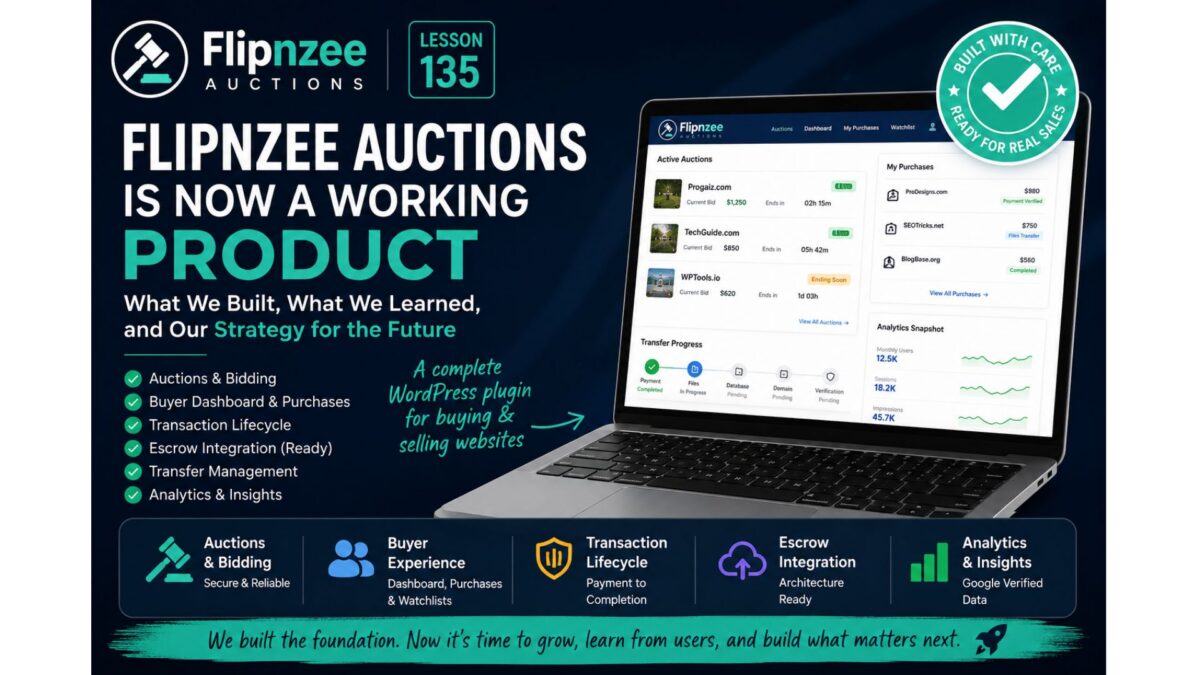
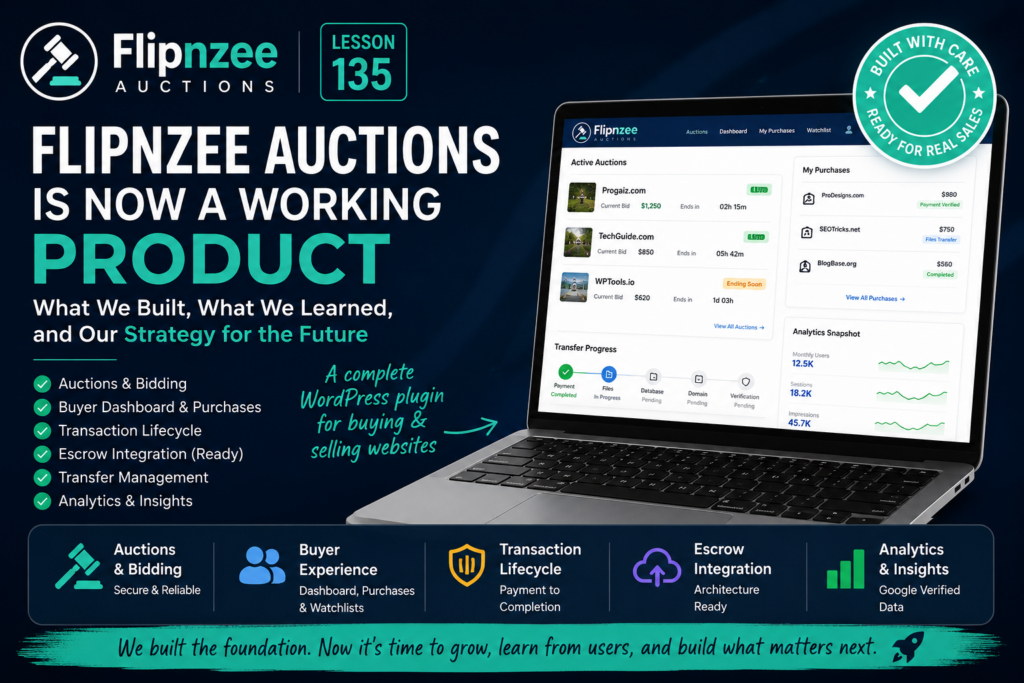
Lesson 135 – Flipnzee Auctions Is Now a Working Product: Lessons Learned and Future Roadmap


Introduction

When this lesson series began, the objective was simple: build a WordPress auction plugin while learning professional plugin development.

Over the course of 135 lessons, that objective gradually evolved.

Instead of producing a tutorial project, the result is a functional auction plugin designed specifically for buying and selling websites, domains, and other digital assets.

Although there are still many possible enhancements, the plugin has reached a point where it can already support real marketplace transactions.

This final lesson summarizes what has been built, the architectural decisions made throughout the series, and where future development may lead.


Looking Back

The project started with a single goal:

Learn WordPress plugin development by building something practical.

Instead of isolated code examples, every lesson contributed to a growing production codebase.

Along the way we explored:

  • WordPress plugin architecture
  • Object-oriented PHP
  • Custom database tables
  • WordPress hooks and filters
  • Secure form handling
  • Shortcodes
  • REST APIs
  • Transaction workflows
  • External provider integrations
  • Database migrations
  • Refactoring techniques
  • Maintainable software design

The result is not merely a collection of lessons but a complete working project.


What the Plugin Already Supports

Today Flipnzee Auctions includes support for:

Auction Management

  • Create auctions
  • Edit auctions
  • Delete auctions
  • Schedule auctions
  • Automatically activate auctions
  • Automatically close expired auctions

Bidding

  • Secure bid placement
  • Highest bidder tracking
  • Bid validation
  • Reserve price support
  • Anti-sniping auction extensions
  • Winner determination

Marketplace

  • Active auction listings
  • Recently closed auctions
  • Analytics summaries
  • Listing thumbnails
  • Countdown timers
  • Buy Now pricing
  • Watchlists

Buyer Experience

  • Buyer Dashboard
  • My Purchases
  • Purchase Details
  • Transaction history
  • Transfer progress

Transaction Management

  • Automatic transaction creation
  • Transaction lifecycle
  • Payment workflow
  • State management
  • Activity logging
  • Notifications

Transfer Workflow

Support for tracking:

  • Payment
  • Website files
  • Database
  • Domain transfer
  • Buyer verification

External Providers

The architecture already supports integration with external services.

Current work includes:

  • Escrow provider abstraction
  • External Provider Manager
  • Escrow API client
  • Provider lifecycle management

Although currently operating in simulation or staged workflows, the underlying architecture has been designed so that additional providers can be added in the future with minimal disruption.


Why Development Slowed Near the End

As the plugin matured, a different question emerged.

Instead of asking:

“Can another feature be built?”

the more important question became:

“Should another feature be built right now?”

There is an important difference.

Software development becomes significantly more valuable when guided by real users rather than assumptions.


The Next Stage Is Validation

The plugin is now capable of supporting real marketplace listings.

Rather than immediately implementing every planned feature, the focus shifts to understanding how buyers actually interact with the marketplace.

Questions that only real users can answer include:

  • Do buyers prefer bidding or Buy Now?
  • How often do negotiations occur before a purchase?
  • Does verified analytics increase buyer confidence?
  • Which information influences purchasing decisions most?
  • Which parts of the purchase workflow deserve automation?

Answers to these questions cannot be discovered through programming alone.

They require real marketplace activity.


Features Deferred Intentionally

Several ideas remain on the roadmap, including:

  • Dedicated Buy Now purchase pages
  • Dynamic Escrow checkout generation
  • Multiple payment providers
  • Stripe integration
  • PayPal integration
  • Wise support
  • Cryptocurrency payments
  • Seller dashboards
  • Public seller onboarding
  • Offer and negotiation workflows
  • Messaging between buyers and sellers
  • Automated transfer checklists
  • Public marketplace analytics

None of these ideas have been abandoned.

They have simply been postponed until real usage demonstrates their value.


An Important Lesson

One of the biggest lessons learned during this project is that good software is not defined by the number of features it contains.

Good software solves real problems while remaining understandable and maintainable.

Throughout the series there were many occasions where existing code was refactored instead of adding new functionality.

Those refactoring lessons were just as valuable as implementing new features because they improved the long-term quality of the project.


The Plugin Is No Longer Just a Tutorial

Although these lessons were written as an educational series, the project gradually became something more.

Flipnzee Auctions is now:

  • a learning resource for WordPress developers,
  • a reference implementation for plugin architecture,
  • and a functional marketplace plugin capable of supporting real website sales.

Future improvements will continue to be driven by practical experience rather than simply expanding the feature list.


Final Thoughts

Building software is rarely about reaching a finish line.

Instead, each release represents a milestone in an ongoing process of learning, refinement, and adaptation.

This lesson series demonstrates that a complex WordPress plugin can be developed incrementally through small, understandable improvements while maintaining a working codebase throughout the journey.

The next chapter for Flipnzee Auctions is no longer primarily about writing code.

It is about observing real users, learning from actual marketplace transactions, and allowing those experiences to guide future development.

For anyone who followed this series from the beginning, thank you for joining the journey. Hopefully it has shown that large software projects are not built in a single leap—they are created one carefully considered lesson at a time.


Series Conclusion

With this lesson, the initial Flipnzee Auctions development series comes to a close.

Future articles will focus less on building features in isolation and more on maintaining, improving, and evolving the plugin based on real-world experience. That transition—from development to product stewardship—is a natural step in the lifecycle of any software project and, arguably, one of the most valuable lessons of all.

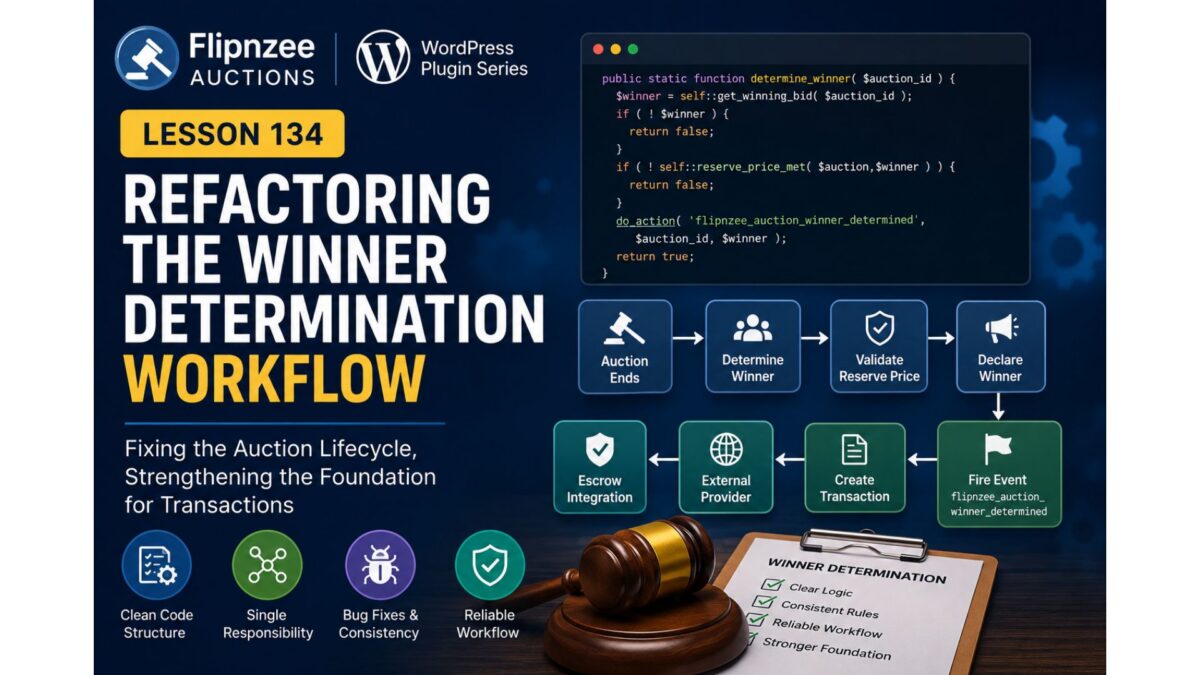
Lesson 134: Refactoring the Winner Determination Workflow (Implementation)

Introduction

In the previous lesson, we analyzed the complete winner determination workflow and discovered that several responsibilities had gradually accumulated inside the Bid Manager.

While debugging the missing transaction creation, it became clear that the underlying issue was not the Transaction Manager or the Escrow integration. Instead, the winner determination process itself had become increasingly difficult to follow due to duplicated logic and mixed responsibilities.

The objective of this lesson was therefore to refactor the workflow before introducing any new marketplace functionality.


Problems Identified

During the review we identified several issues.

  • Reserve price validation appeared in multiple places.
  • Winner determination and reserve checking were tightly coupled.
  • The workflow was difficult to trace from auction completion to transaction creation.
  • Debugging required following several nested function calls.
  • Future payment integrations would become increasingly difficult.

Rather than continuing to build on top of this complexity, the decision was made to simplify the workflow.


Refactoring Goals

The refactoring focused on three objectives.

Single Responsibility

Each function should perform one task.

For example:

  • Determine winner
  • Validate reserve price
  • Fire events
  • Create transaction

should all remain separate operations.


Clear Event Flow

The winner determination process now follows a predictable sequence.

Auction Ends
      │
      ▼
Determine Highest Bid
      │
      ▼
Validate Reserve Price
      │
      ▼
Declare Winner
      │
      ▼
Fire Winner Event
      │
      ▼
Transaction Manager
      │
      ▼
External Provider Manager
      │
      ▼
Escrow API Client

Easier Debugging

Instead of wondering whether the Transaction Manager was malfunctioning, it became possible to inspect the workflow step by step.

Each stage now represents a clear transition in the auction lifecycle.


Why This Matters

Although this refactoring produced very little visible change on the frontend, it significantly improved the internal architecture.

A well-defined event flow makes it easier to:

  • integrate new payment providers
  • add notifications
  • automate transactions
  • create audit logs
  • support additional marketplace features

without repeatedly modifying the Bid Manager.


Result

The Flipnzee Auctions plugin now has a cleaner winner determination workflow that separates auction logic from payment processing.

This architectural improvement provides a stable foundation for the next phase of development, where the marketplace begins evolving beyond simple bidding into a complete purchasing experience.


Next Lesson

In the next lesson we begin connecting auctions with secure payments by redesigning the Buy Now workflow around Escrow.com.

Rather than treating Buy Now as the end of the auction, it will become the beginning of a secure purchasing process.

Lesson 134: Refactoring the Winner Determination Workflow

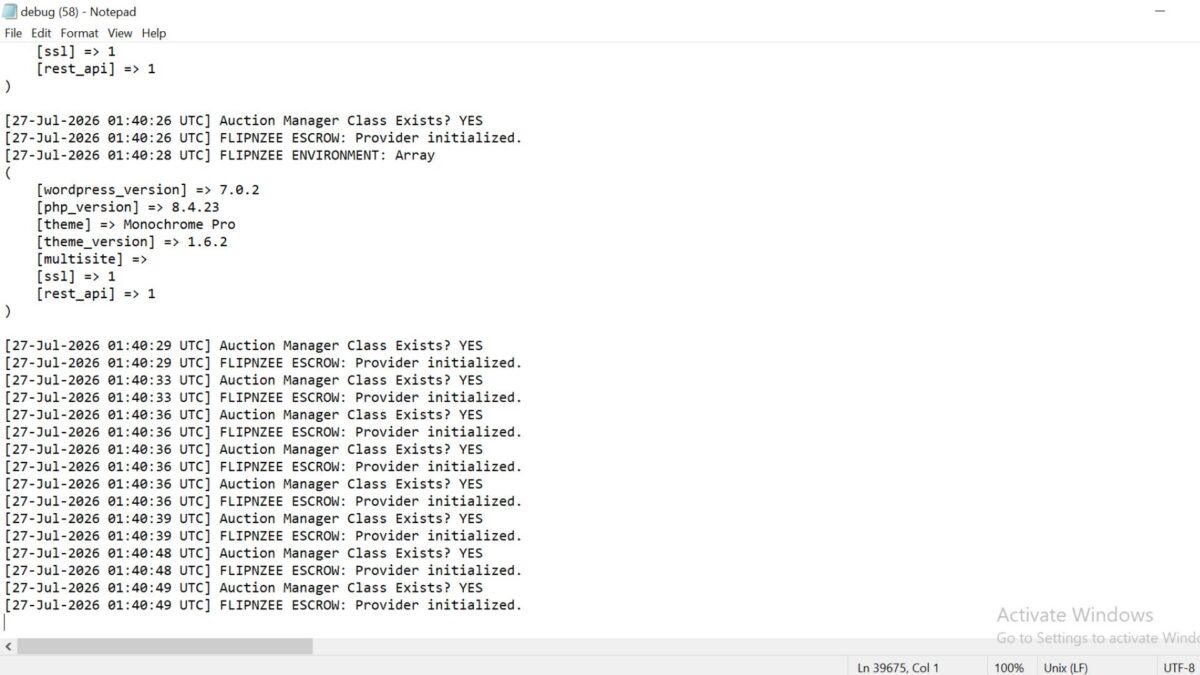
As the Escrow integration matured, testing uncovered an unexpected issue. Although the transaction management architecture had been significantly improved, transaction creation was still not occurring when an auction completed. Rather than immediately assuming the problem existed inside the new transaction code, a systematic review of the auction lifecycle was performed.

This lesson documents the investigation, identifies the true source of the problem, and begins refactoring the winner determination workflow.


The Initial Symptoms

The plugin loaded successfully.

The logs confirmed:

  • Auction Manager initialized.
  • Escrow Provider initialized.
  • Transaction Manager instantiated.

However, one important log entry never appeared:

FLIPNZEE: create_transaction_from_auction() started.

This indicated that the transaction manager itself was not the source of the problem.


Following the Execution Path

Instead of modifying more code, the auction completion workflow was traced step by step.

The execution path is:

Auction Ends
      │
      ▼
Determine Winner
      │
      ▼
Fire Winner Event
      │
      ▼
Transaction Manager
      │
      ▼
Create Transaction
      │
      ▼
Create External Provider
      │
      ▼
Escrow API

Since the Transaction Manager never received control, the investigation moved further upstream.


Reviewing the Bid Manager

The winner determination logic resides inside the Bid Manager.

The following event was confirmed to exist:

do_action(
    'flipnzee_auction_winner_determined',
    $auction_id,
    $winner
);

The event itself was not missing.

Instead, attention shifted to the code responsible for deciding whether a winner should be declared.


Problems Identified

During inspection, the reserve price validation logic had become increasingly difficult to follow after several previous feature additions.

Several architectural issues were identified.

Mixed Responsibilities

The reserve price helper was no longer acting as a simple validation function.

Instead, it contained:

  • Database queries
  • Activity logging
  • Winner modification
  • Business rules
  • Validation logic

A helper function should ideally perform only one task.


Recursive Logic

The helper contained recursive calls back into itself.

This unnecessarily complicated the control flow and made debugging much harder.


Inconsistent Parameters

Different parts of the code expected different inputs.

Some calls passed:

Auction ID

while the helper expected:

Auction Object

This inconsistency made the workflow fragile and difficult to reason about.


Duplicate Business Rules

Reserve price validation appeared in multiple locations.

When business rules are duplicated:

  • bugs become harder to fix,
  • future changes become risky,
  • behavior can become inconsistent.

A single source of truth is always preferable.


Why This Matters

The transaction system depends entirely on the auction lifecycle.

If the winner determination process is unstable, then:

  • transactions cannot be created,
  • provider records cannot be generated,
  • Escrow integration cannot begin.

Rather than continuing to build on uncertain foundations, the focus shifted toward stabilizing the auction lifecycle first.


Architectural Principle

This lesson reinforced an important software engineering principle.

Each stage of the workflow should have one clearly defined responsibility.

Determine Winner
        │
        ▼
Validate Reserve Price
        │
        ▼
Declare Winner
        │
        ▼
Fire Event
        │
        ▼
Create Transaction

When each stage performs only one job, the entire workflow becomes easier to understand, test, and extend.


Benefits of the Refactor

Although this lesson does not introduce new user-facing functionality, it significantly improves the maintainability of the codebase.

Benefits include:

  • Cleaner control flow.
  • Easier debugging.
  • Reduced code duplication.
  • Better separation of concerns.
  • More predictable transaction lifecycle.
  • Stronger foundation for Escrow integration.

Looking Ahead

With the transaction architecture now largely complete and the root cause isolated to the winner determination workflow, the next phase will focus on simplifying the reserve price validation logic into a dedicated, single-purpose component.

Once the auction lifecycle is fully stabilized, the transaction manager, external provider manager, and Escrow integration will operate on a much more reliable foundation.


Lesson 134 demonstrates that effective debugging is often about validating assumptions rather than immediately writing new code. By tracing the complete execution path and identifying weaknesses in the winner determination workflow, Flipnzee Auctions moves closer to a robust, maintainable architecture capable of supporting future payment providers and marketplace features.

Lesson 133: Refactoring the External Provider Manager

As Flipnzee Auctions continued to evolve, it became clear that the External Provider Manager was beginning to take on too many responsibilities. Earlier implementations mixed database operations, provider selection, and external API communication inside a single class. While functional, this made the code difficult to extend and harder to maintain.

In this lesson, the architecture was refactored so that each component has a single, well-defined responsibility. Although no new user-facing functionality was added, this refactoring lays the foundation for future integrations with Escrow.com and other external transaction providers.


Why This Refactor Was Needed

The original implementation blurred several different responsibilities:

  • Creating local provider records.
  • Communicating with external APIs.
  • Updating provider metadata.
  • Managing provider lifecycle.

As the Escrow integration matured, it became apparent that separating these concerns would produce cleaner, more maintainable code.

The objective of this lesson was not to change functionality, but to improve the plugin architecture.


New Responsibilities

The transaction workflow is now organized into distinct layers.

Transaction Manager
        │
        ▼
External Provider Manager
        │
        ▼
Escrow API Client
        │
        ▼
Escrow.com

Each layer now performs only one job.

Transaction Manager

Responsible for:

  • Creating internal transactions.
  • Creating local provider records.
  • Building canonical transaction payloads.
  • Coordinating provider synchronization.

External Provider Manager

Responsible for:

  • Managing provider database records.
  • Delegating API requests to the appropriate provider client.
  • Synchronizing provider metadata.

It no longer performs HTTP requests directly.

Escrow API Client

Responsible for:

  • Payload validation.
  • API communication.
  • Response normalization.
  • Returning a standardized result to the application.

Provider Record Lifecycle

When a transaction is created, Flipnzee now creates an associated provider record before contacting the external provider.

The lifecycle is:

Create Transaction
        │
        ▼
Create Provider Record
        │
        ▼
Call Escrow API
        │
        ▼
Receive Response
        │
        ▼
Update Provider Record

This approach ensures every external transaction can be tracked independently from the auction transaction itself.


New Provider Synchronization

A new update_provider() method was introduced to synchronize provider information after receiving a successful response from the external provider.

Typical fields include:

  • Provider reference
  • Provider URL
  • Current provider status
  • Updated timestamp

This keeps the local database synchronized with the external provider without coupling database logic to the API client.


Improved Logging

Additional logging was added throughout the provider lifecycle.

Examples include:

  • Provider record creation
  • Provider synchronization
  • Failed provider updates
  • Database errors

These logs make debugging significantly easier during development and future integrations.


Cleaner Separation of Concerns

One of the biggest improvements introduced in this lesson is architectural rather than functional.

Instead of one large class handling everything, each class now has a clearly defined responsibility.

This makes it easier to:

  • Add new payment providers.
  • Replace existing providers.
  • Unit test components individually.
  • Extend the plugin without affecting unrelated functionality.

Current Status

While the External Provider Manager refactoring is now largely complete, testing also revealed that parts of the auction winner determination workflow require additional cleanup before the full transaction pipeline can be considered production-ready.

In particular, the reserve price validation logic inside the Bid Manager has accumulated duplicate and inconsistent code during previous iterations. Rather than layering additional features on top of unstable logic, the next lesson will focus on simplifying and stabilizing the winner determination process before continuing with further provider synchronization enhancements.

This is a good example of how software engineering often involves improving existing architecture before introducing new functionality. Careful refactoring at the right time helps keep a growing project maintainable and reduces the likelihood of subtle bugs appearing later as new features are added.


Lesson 133 demonstrates an important software engineering principle: clean architecture is an investment. By separating provider management, transaction orchestration, and external API communication into independent components, Flipnzee Auctions becomes easier to maintain today and significantly easier to extend in the future.

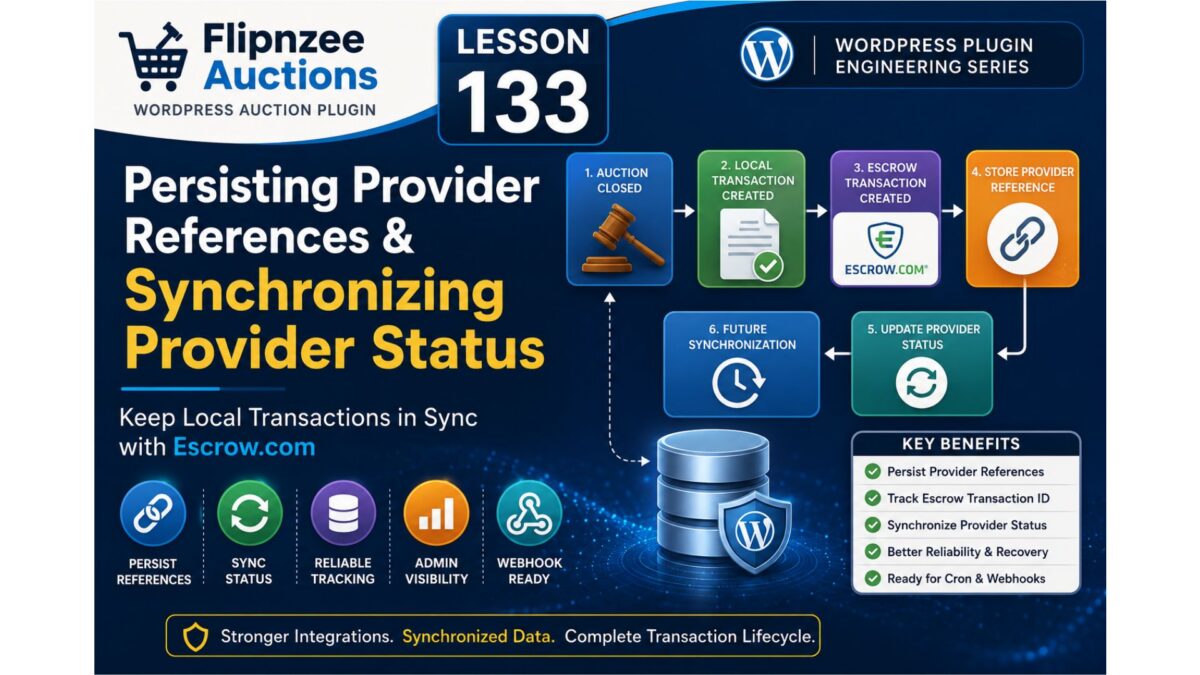
Lesson 133: Persisting Provider References and Synchronizing Provider Status

With the transaction payload standardized in Lesson 132, the Flipnzee Auctions plugin now has a consistent way to exchange transaction data between its internal components. The next step is ensuring that information returned by external providers is not lost.

Creating an Escrow transaction is only half of the process. Once the provider responds, the plugin should store the provider’s transaction reference, record its current status, and keep the local database synchronized with the external service.

Lesson 133 focuses on completing that connection.


Why this lesson is important

Until now, the transaction workflow has looked like this:

Auction Closed
      │
      ▼
Local Transaction Created
      │
      ▼
External Provider Record Created
      │
      ▼
Escrow API Request
      │
      ▼
Response Returned

Although the API returns useful information, much of it is not yet persisted for future use.

Without storing provider references, the plugin cannot reliably:

  • Revisit an external transaction
  • Check its latest status
  • Display provider information in the admin area
  • Recover gracefully after temporary API failures

The Goal

After this lesson, every successful provider transaction should immediately update the corresponding provider record.

The workflow becomes:

Auction Closed
      │
      ▼
Local Transaction
      │
      ▼
Create Provider Record
      │
      ▼
Escrow Transaction
      │
      ▼
Store Provider Reference
      │
      ▼
Update Provider Status
      │
      ▼
Future Synchronization

The provider record becomes the permanent link between Flipnzee Auctions and the external provider.


Provider Information to Store

When a provider successfully creates a transaction, the plugin should save information such as:

  • Provider transaction reference
  • Current provider status
  • Provider transaction URL (when available)
  • Last updated timestamp
  • Synchronization notes

Persisting this information ensures that future API calls always know which external transaction they belong to.


Synchronizing Status

Rather than leaving every provider record in a generic “Pending” state, the plugin will begin recording the actual status returned by the provider.

Typical values may include:

  • Created
  • Awaiting Payment
  • Payment Received
  • In Progress
  • Completed
  • Cancelled

Using normalized status values makes the rest of the plugin independent of provider-specific terminology.


Strengthening the External Provider Manager

The External Provider Manager now evolves from simply forwarding API requests into coordinating provider lifecycle management.

Its responsibilities include:

  • Sending provider requests
  • Validating provider responses
  • Saving provider references
  • Updating provider status
  • Returning standardized results to the Transaction Manager

This keeps provider-specific behavior isolated from the rest of the application.


Benefits

Persistent Transaction Tracking

Every auction remains permanently linked to its external provider transaction.

Better Administration

Administrators can identify provider transactions without manually searching the external platform.

Improved Reliability

If synchronization fails, the stored provider reference allows the plugin to retry later.

Foundation for Scheduled Synchronization

Saving provider identifiers prepares the plugin for future background status checks using WP-Cron.

Webhook Ready

Future webhook events can immediately identify the correct local transaction because the provider reference has already been stored.


Architecture After Lesson 133

Auction Closed
      │
      ▼
Transaction Manager
      │
      ▼
Canonical Transaction Payload
      │
      ▼
External Provider Manager
      │
      ▼
Escrow API Client
      │
      ▼
Persist Provider Reference
      │
      ▼
Synchronize Provider Status
      │
      ▼
Local Database

This completes the core transaction lifecycle by ensuring that local records remain connected to their corresponding external transactions.


What We Will Implement

During this lesson we will:

  • Process successful responses returned by the Escrow API client.
  • Persist provider transaction references in the database.
  • Update provider status automatically after transaction creation.
  • Store provider URLs when available.
  • Record synchronization timestamps.
  • Improve activity logging for provider creation and status updates.
  • Prepare the architecture for future scheduled synchronization and webhook support.

What You’ll Learn

By completing Lesson 133, you’ll gain practical experience with:

  • Synchronizing local records with external services.
  • Designing reliable provider integrations.
  • Persisting external identifiers for long-term tracking.
  • Building extensible transaction workflows.
  • Preparing a WordPress plugin for production-grade third-party integrations.

Next Lesson

Lesson 134 will introduce an External Provider Management screen within the WordPress admin area, allowing administrators to view provider records, monitor synchronization status, inspect provider references, and manage external transactions from a single dashboard.

Lesson 132 Implementation: Standardizing the Transaction Payload

As the Flipnzee Auctions plugin continued to evolve, one architectural issue became increasingly apparent. Although the Transaction Manager, External Provider Manager, and Escrow API Client all worked together, each component constructed or interpreted transaction data slightly differently.

This lesson introduces a significant refactoring by defining a canonical transaction payload that is shared across the entire Escrow integration workflow.

Rather than rebuilding transaction data at each layer, a single standardized payload is now created and passed unchanged throughout the transaction lifecycle.


Why this refactoring was necessary

Prior to Lesson 132, each component handled transaction information independently.

The Transaction Manager assembled transaction details before invoking the External Provider Manager. The Provider Manager then rebuilt another payload before sending it to the Escrow API Client. Finally, the API Client performed its own validation of required fields.

Although functional, this approach resulted in duplicated logic and increased the risk of inconsistencies whenever transaction fields changed.

The architecture previously resembled:

Transaction Manager
        │
        ▼
Creates Payload A
        │
        ▼
External Provider Manager
        │
        ▼
Creates Payload B
        │
        ▼
Escrow API Client

Every translation introduced another opportunity for errors.


Building a Canonical Transaction Payload

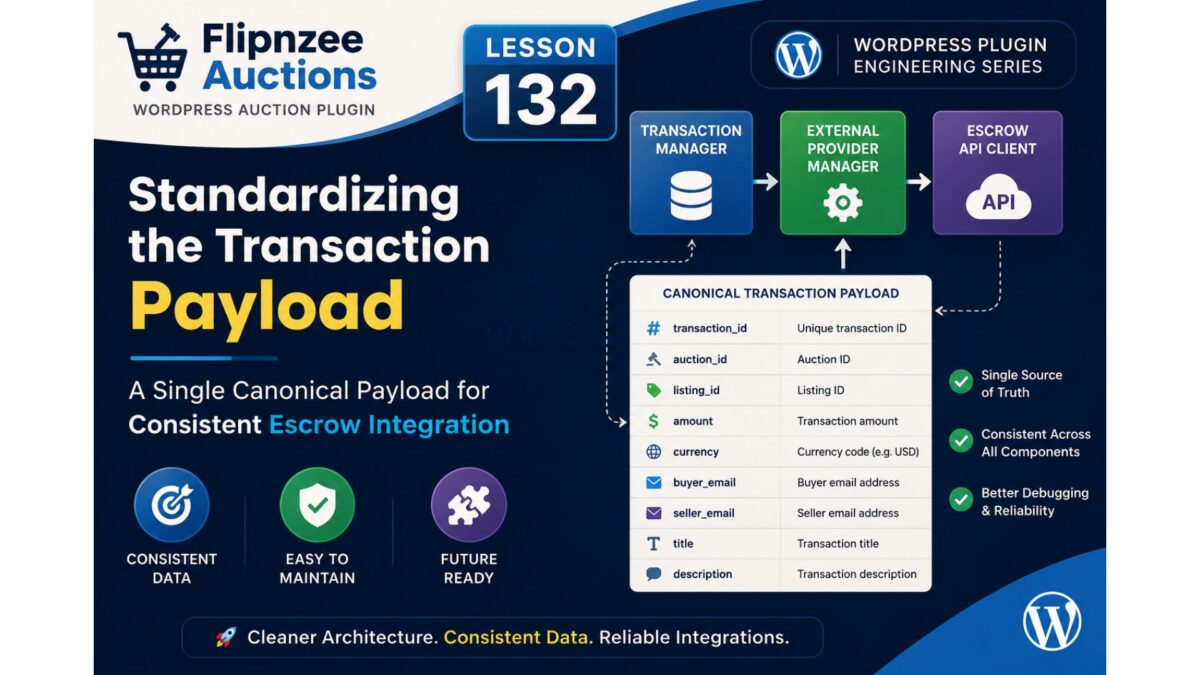
Lesson 132 establishes the Transaction Manager as the single source of truth for transaction data.

A complete transaction payload is now created immediately after the local transaction record is generated.

The payload includes:

  • Transaction ID
  • Auction ID
  • Listing ID
  • Winning amount
  • Currency
  • Buyer ID
  • Seller ID
  • Buyer email
  • Seller email
  • Transaction title
  • Description

Instead of reconstructing missing values later, all required information now travels together through the integration.


Simplifying the External Provider Manager

The External Provider Manager has been refactored into a validation and routing layer.

Rather than generating missing transaction fields, it now performs two responsibilities:

  • Validate the incoming payload.
  • Pass the standardized payload directly to the Escrow API Client.

This significantly reduces duplicated business logic while making the provider layer much easier to maintain.


Improved API Validation

The Escrow API Client now validates the canonical payload before attempting any API communication.

Required fields are checked consistently, allowing missing or invalid data to be detected immediately before an HTTP request is made.

This results in clearer error reporting and a more predictable transaction workflow.


Architectural Improvements

The transaction flow is now much simpler.

Before

Auction Closed
      │
      ▼
Transaction Manager
      │
      ▼
Creates Custom Payload
      │
      ▼
External Provider Manager
      │
      ▼
Creates Another Payload
      │
      ▼
Escrow API Client

After

Auction Closed
      │
      ▼
Transaction Manager
      │
      ▼
Canonical Transaction Payload
      │
      ▼
External Provider Manager
      │
      ▼
Escrow API Client
      │
      ▼
Simulation / Sandbox / Production

Every component now communicates using the same data contract.


Benefits

This refactoring provides several long-term advantages.

Single Source of Truth

Transaction information is created once and reused throughout the integration.

Reduced Code Duplication

Provider-specific classes no longer recreate values that already exist.

Easier Debugging

Developers can inspect a single payload throughout the transaction lifecycle instead of tracing multiple array transformations.

Better Maintainability

Adding or modifying transaction fields now requires changes in only one location.

Future Provider Support

Additional payment providers can consume the same standardized payload without requiring custom payload builders.


Current Status

With Lesson 132 complete, the Escrow integration architecture has become considerably cleaner.

The plugin now consists of clearly separated responsibilities:

  • Transaction Manager
  • External Provider Manager
  • Escrow API Client
  • Canonical Transaction Payload
  • Simulation, Sandbox, and Production environments

This standardized data contract lays a solid foundation for future provider integrations while reducing complexity across the transaction workflow.

https://github.com/SplendidDigital/flipnzee-auctions/releases/tag/lesson-132-stable


Next Lesson

Lesson 133 will focus on persisting provider references and synchronizing provider status. The plugin will begin storing external transaction identifiers returned by Escrow.com and updating local provider records with the latest status, preparing the system for ongoing synchronization and future webhook support.

Lesson 132: Standardizing the Transaction Payload Across the Escrow Integration

In the previous lesson, the External Provider Manager was introduced as an abstraction layer between the Flipnzee Auctions plugin and external payment providers. This significantly improved the architecture by separating transaction management from provider-specific logic.

During testing, however, another issue became apparent. Different components were building and consuming transaction data in slightly different formats. While the Transaction Manager, External Provider Manager, and Escrow API Client all exchanged arrays of data, they did not always agree on which fields should exist or what they should be called.

Lesson 132 focuses on solving this problem by introducing a canonical transaction payload.


The Problem

Prior to this lesson, each component expected slightly different data.

For example:

  • Transaction Manager created transaction information.
  • External Provider Manager rebuilt parts of the payload.
  • Escrow API Client validated fields independently.

Although this worked in simple scenarios, it made debugging difficult because each layer could modify or recreate the transaction data.

The architecture looked like this:

Transaction Manager
        │
        ▼
Creates custom payload
        │
        ▼
External Provider Manager
        │
        ▼
Creates another payload
        │
        ▼
Escrow API Client

Every translation introduced another opportunity for inconsistencies.


The Solution

Lesson 132 introduces a single canonical payload structure that travels unchanged through the Escrow integration.

Instead of rebuilding arrays multiple times, the Transaction Manager becomes the authoritative source of transaction data.

The new workflow becomes:

Transaction Manager
        │
        ▼
Canonical Transaction Payload
        │
        ▼
External Provider Manager
        │
        ▼
Escrow API Client

Every component now speaks the same language.


Canonical Payload

The standardized transaction payload contains all information required by the provider layer.

Typical fields include:

  • Transaction ID
  • Auction ID
  • Listing ID
  • Amount
  • Currency
  • Buyer email
  • Seller email
  • Title
  • Description

Rather than generating missing values later, these are prepared once and reused throughout the transaction lifecycle.


Benefits

Single Source of Truth

Transaction information is generated once and remains consistent throughout the workflow.


Easier Debugging

When an API request fails, developers can inspect one payload instead of tracing multiple array transformations across different classes.


Reduced Code Duplication

Provider managers no longer recreate values already available from the Transaction Manager.


Better Maintainability

Future changes to transaction fields require updates in only one location instead of several independent methods.


Improved Extensibility

Additional payment providers can consume the same payload without requiring provider-specific transaction builders.

This makes future integrations significantly easier.


Architectural Improvement

The transaction flow is now much cleaner.

Before:

Transaction Manager
        │
        ▼
Creates Payload A
        │
        ▼
External Provider Manager
        │
        ▼
Creates Payload B
        │
        ▼
Escrow API Client

After:

Transaction Manager
        │
        ▼
Canonical Transaction Payload
        │
        ▼
External Provider Manager
        │
        ▼
Escrow API Client

This removes unnecessary translation layers while making the integration easier to understand.


What We Will Implement

During this lesson we will:

  • Define the canonical transaction payload.
  • Refactor the Transaction Manager to construct the payload once.
  • Remove duplicate payload construction from the External Provider Manager.
  • Ensure the Escrow API Client consumes the standardized structure directly.
  • Improve logging so the same payload can be traced throughout the entire transaction lifecycle.

What We’ll Learn

By the end of Lesson 132, you will understand:

  • Why a canonical data structure simplifies software architecture.
  • How to reduce coupling between components.
  • How consistent data contracts improve debugging and maintenance.
  • Why production-quality plugins rely on standardized payloads rather than ad hoc arrays.

Next Lesson

Lesson 133 will focus on persisting Escrow provider references and synchronizing provider status with local transactions, allowing the plugin to track external transaction identifiers and keep local records aligned with the provider throughout the transaction lifecycle.

Lesson 131 Implementation: Introducing the External Provider Manager

In the previous lessons, the Escrow API client was refactored into a reusable HTTP client capable of communicating with Escrow.com in Simulation, Sandbox, and Production environments. While this significantly improved the networking layer, the rest of the plugin still interacted directly with the Escrow client.

This lesson introduces an important architectural improvement: the External Provider Manager.

Rather than allowing business logic to communicate directly with a specific payment provider, all external transaction providers are now accessed through a common manager. Although Escrow.com is currently the only supported provider, this abstraction makes the plugin easier to maintain and allows additional providers to be introduced in the future without affecting the transaction workflow.


Why this refactoring was needed

Prior to this lesson, various parts of the plugin were aware of the Escrow API client itself. That meant changing providers or supporting multiple providers would require modifications throughout the codebase.

The new architecture centralizes that responsibility.

Instead of:

Transaction Manager
        │
        ▼
Escrow API Client

the flow now becomes:

Transaction Manager
        │
        ▼
External Provider Manager
        │
        ▼
Escrow API Client

The Transaction Manager no longer needs to know how Escrow transactions are created. It simply requests that an external transaction be created using the configured provider.


What was implemented

Lesson 131 introduces the Flipnzee_External_Provider_Manager class as the single entry point for external transaction providers.

The manager now:

  • Accepts a provider identifier.
  • Validates the requested provider.
  • Creates an Escrow API client when required.
  • Converts internal transaction data into an Escrow-compatible payload.
  • Returns a standardized response to the calling code.

This keeps provider-specific logic isolated from the rest of the plugin.


Escrow payload builder

A dedicated payload builder was added to translate Flipnzee transaction data into the format expected by the Escrow API client.

Typical information included in the payload includes:

  • Transaction title
  • Description
  • Amount
  • Currency
  • Buyer email
  • Seller email

Keeping this translation in one place makes future API changes much easier to accommodate.


Standardized provider responses

The Provider Manager also ensures callers always receive a consistent response structure.

Whether the request succeeds or fails, the calling code receives a predictable array describing:

  • Success or failure
  • Message
  • Provider response

This avoids provider-specific handling throughout the plugin.


Benefits

This refactoring provides several long-term advantages.

Separation of responsibilities

The Transaction Manager no longer performs provider-specific work.

Improved maintainability

Changes to Escrow integration are now isolated within the provider layer.

Easier testing

Simulation Mode, Sandbox, and Production all continue to function without requiring changes elsewhere in the plugin.

Future extensibility

Supporting additional transaction providers becomes significantly easier because the Transaction Manager communicates only with the Provider Manager rather than individual provider implementations.

Potential future providers could include:

  • Escrow.com
  • Trustap
  • Stripe Connect
  • Manual escrow workflows
  • Additional marketplace services

Current status

At the end of Lesson 131, the overall architecture has matured considerably.

The plugin now consists of:

  • Transaction Manager
  • External Provider Manager
  • Escrow Provider
  • Refactored Escrow API Client
  • Simulation, Sandbox, and Production environments

While additional work remains before production-ready Escrow integration is complete, the major architectural foundation is now in place.


Next lesson

Lesson 132 will focus on standardizing the transaction payload shared between the Transaction Manager, External Provider Manager, and Escrow API Client. Establishing a single canonical payload will simplify debugging, eliminate duplicated mapping logic, and prepare the integration for reliable end-to-end transaction processing.

Lesson 131 – Creating the First Real Escrow Transaction

Over the previous lessons, we’ve focused on building a reliable foundation for the Escrow integration within Flipnzee Auctions. We’ve introduced environment management, refactored the API client, standardized response handling, and built a production-ready administration interface.

Although the plugin is now capable of communicating with Escrow.com, it still isn’t performing the task it was ultimately designed for—creating real Escrow transactions.

In this lesson, that changes.

We’ll implement the first step of the complete Escrow transaction lifecycle by creating an actual Escrow transaction through the refactored API client.


Where We Stand

At the end of Lesson 130, the plugin supports:

  • Simulation environment
  • Sandbox environment
  • Production environment
  • Credential validation
  • Connection testing
  • Standardized API responses
  • Configuration dashboard

The networking layer is complete enough to begin sending real business requests.


The Missing Piece

Winning an auction currently updates the local database.

The plugin knows:

  • the winning bidder,
  • the auction,
  • the final price,
  • the payment provider.

However, nothing is yet created at Escrow.com.

The workflow still ends inside WordPress.


Current Workflow

Today’s workflow looks like this:

Auction Ends
        │
        ▼
Winner Selected
        │
        ▼
Local Transaction Created
        │
        ▼
END

While useful, this means the administrator must manually create an Escrow transaction.

That defeats the purpose of integrating directly with Escrow.com.


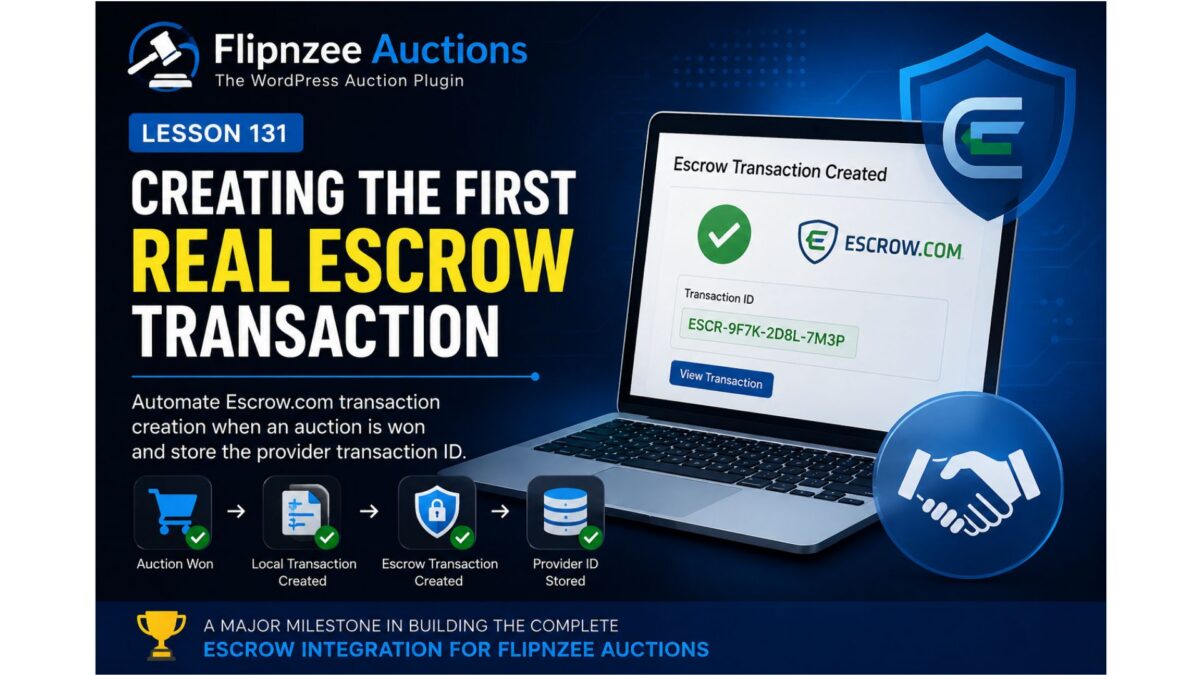
New Workflow

After Lesson 131, the process becomes significantly more powerful.

Auction Ends
        │
        ▼
Winner Selected
        │
        ▼
Local Transaction Created
        │
        ▼
Escrow Transaction Created
        │
        ▼
Provider Transaction ID Stored

This becomes the beginning of the complete payment lifecycle.


Objectives

The primary objective of this lesson is to automate the creation of an Escrow transaction whenever the plugin is ready to initiate payment.

By the end of this lesson, Flipnzee Auctions will be capable of requesting a new transaction from Escrow.com using the existing API client.


Building on Existing Architecture

One advantage of the previous refactoring work is that almost everything required already exists.

The plugin already provides:

  • Escrow API Client
  • External Provider Manager
  • Transaction Manager
  • Standardized responses
  • Environment management

Rather than introducing a completely new architecture, this lesson simply connects these existing components together.


Transaction Creation

The Escrow API client already understands how to communicate with the selected environment.

We’ll now extend it with support for creating transactions.

The request will include information such as:

  • auction identifier,
  • transaction amount,
  • buyer,
  • seller,
  • currency,
  • description.

Initially, the request will focus on the minimum data required to establish the transaction.

Additional metadata can be added in future lessons.


Provider Transaction IDs

One of the most important pieces of information returned by Escrow.com is its transaction identifier.

This identifier becomes the permanent link between:

  • Flipnzee Auctions
  • Escrow.com

Rather than relying solely on local transaction IDs, the plugin will now store the provider’s unique identifier for future synchronization.


Centralized Workflow

Instead of allowing different parts of the plugin to communicate directly with Escrow.com, all requests will continue flowing through the Escrow API client.

The architecture remains:

Auction
      │
      ▼
Transaction Manager
      │
      ▼
External Provider Manager
      │
      ▼
Escrow API Client
      │
      ▼
Escrow.com

Maintaining this separation keeps networking concerns isolated from business logic.


Error Handling

Creating an external transaction introduces new failure scenarios.

Examples include:

  • network failures,
  • authentication errors,
  • invalid request data,
  • temporary provider outages.

Rather than assuming success, the plugin will continue using the standardized response format introduced in earlier lessons.

This ensures consistent error handling throughout the integration.


Preparing for Synchronization

Creating the transaction is only the beginning.

Future lessons will build upon the provider transaction identifier to support:

  • transaction synchronization,
  • status updates,
  • payment completion,
  • cancellations,
  • dispute handling,
  • webhook processing.

Lesson 131 establishes the foundation upon which these features will be built.


Expected Outcome

After completing this lesson, Flipnzee Auctions will no longer stop after creating a local transaction.

Instead, it will immediately communicate with the configured Escrow environment and request creation of a corresponding provider transaction.

The resulting provider identifier will be stored locally, allowing future synchronization with Escrow.com.


Conclusion

Configuration alone does not create business value. Real value begins when software starts automating real-world workflows.

Lesson 131 represents one of the most significant milestones in the Flipnzee Auctions project. For the first time, the plugin moves beyond configuration and local transaction management to begin interacting directly with Escrow.com as part of the auction lifecycle.

In the next implementation lesson, we’ll connect the auction workflow to the Escrow API client, create our first provider transaction, and persist the returned transaction identifier for future synchronization.