
Lesson 134: Refactoring the Winner Determination Workflow

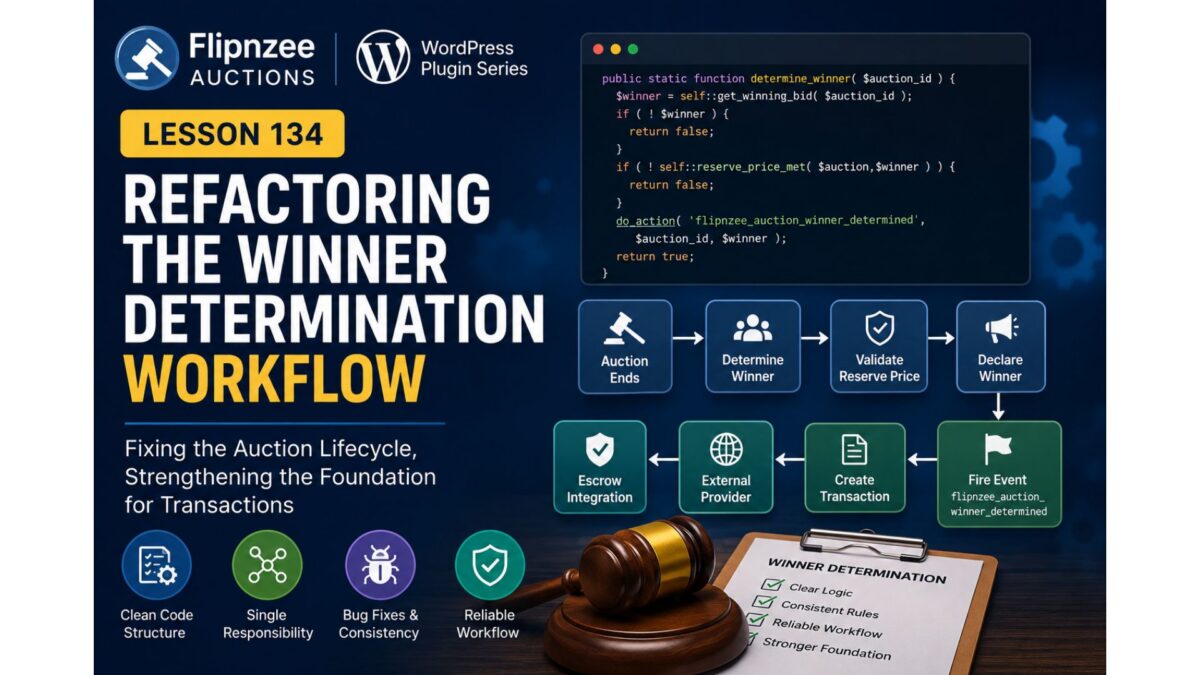
As the Escrow integration matured, testing uncovered an unexpected issue. Although the transaction management architecture had been significantly improved, transaction creation was still not occurring when an auction completed. Rather than immediately assuming the problem existed inside the new transaction code, a systematic review of the auction lifecycle was performed.
This lesson documents the investigation, identifies the true source of the problem, and begins refactoring the winner determination workflow.
The Initial Symptoms
The plugin loaded successfully.
The logs confirmed:
- Auction Manager initialized.
- Escrow Provider initialized.
- Transaction Manager instantiated.
However, one important log entry never appeared:
FLIPNZEE: create_transaction_from_auction() started.
This indicated that the transaction manager itself was not the source of the problem.
Following the Execution Path
Instead of modifying more code, the auction completion workflow was traced step by step.
The execution path is:
Auction Ends
      │
      ▼
Determine Winner
      │
      ▼
Fire Winner Event
      │
      ▼
Transaction Manager
      │
      ▼
Create Transaction
      │
      ▼
Create External Provider
      │
      ▼
Escrow API
Since the Transaction Manager never received control, the investigation moved further upstream.
Reviewing the Bid Manager
The winner determination logic resides inside the Bid Manager.
The following event was confirmed to exist:
do_action(
    'flipnzee_auction_winner_determined',
    $auction_id,
    $winner
);
The event itself was not missing.
Instead, attention shifted to the code responsible for deciding whether a winner should be declared.
Problems Identified
During inspection, the reserve price validation logic had become increasingly difficult to follow after several previous feature additions.
Several architectural issues were identified.
Mixed Responsibilities
The reserve price helper was no longer acting as a simple validation function.
Instead, it contained:
- Database queries
- Activity logging
- Winner modification
- Business rules
- Validation logic
A helper function should ideally perform only one task.
Recursive Logic
The helper contained recursive calls back into itself.
This unnecessarily complicated the control flow and made debugging much harder.
Inconsistent Parameters
Different parts of the code expected different inputs.
Some calls passed:
Auction ID
while the helper expected:
Auction Object
This inconsistency made the workflow fragile and difficult to reason about.
Duplicate Business Rules
Reserve price validation appeared in multiple locations.
When business rules are duplicated:
- bugs become harder to fix,
- future changes become risky,
- behavior can become inconsistent.
A single source of truth is always preferable.
Why This Matters
The transaction system depends entirely on the auction lifecycle.
If the winner determination process is unstable, then:
- transactions cannot be created,
- provider records cannot be generated,
- Escrow integration cannot begin.
Rather than continuing to build on uncertain foundations, the focus shifted toward stabilizing the auction lifecycle first.
Architectural Principle
This lesson reinforced an important software engineering principle.
Each stage of the workflow should have one clearly defined responsibility.
Determine Winner
        │
        ▼
Validate Reserve Price
        │
        ▼
Declare Winner
        │
        ▼
Fire Event
        │
        ▼
Create Transaction
When each stage performs only one job, the entire workflow becomes easier to understand, test, and extend.
Benefits of the Refactor
Although this lesson does not introduce new user-facing functionality, it significantly improves the maintainability of the codebase.
Benefits include:
- Cleaner control flow.
- Easier debugging.
- Reduced code duplication.
- Better separation of concerns.
- More predictable transaction lifecycle.
- Stronger foundation for Escrow integration.
Looking Ahead
With the transaction architecture now largely complete and the root cause isolated to the winner determination workflow, the next phase will focus on simplifying the reserve price validation logic into a dedicated, single-purpose component.
Once the auction lifecycle is fully stabilized, the transaction manager, external provider manager, and Escrow integration will operate on a much more reliable foundation.
Lesson 134 demonstrates that effective debugging is often about validating assumptions rather than immediately writing new code. By tracing the complete execution path and identifying weaknesses in the winner determination workflow, Flipnzee Auctions moves closer to a robust, maintainable architecture capable of supporting future payment providers and marketplace features.