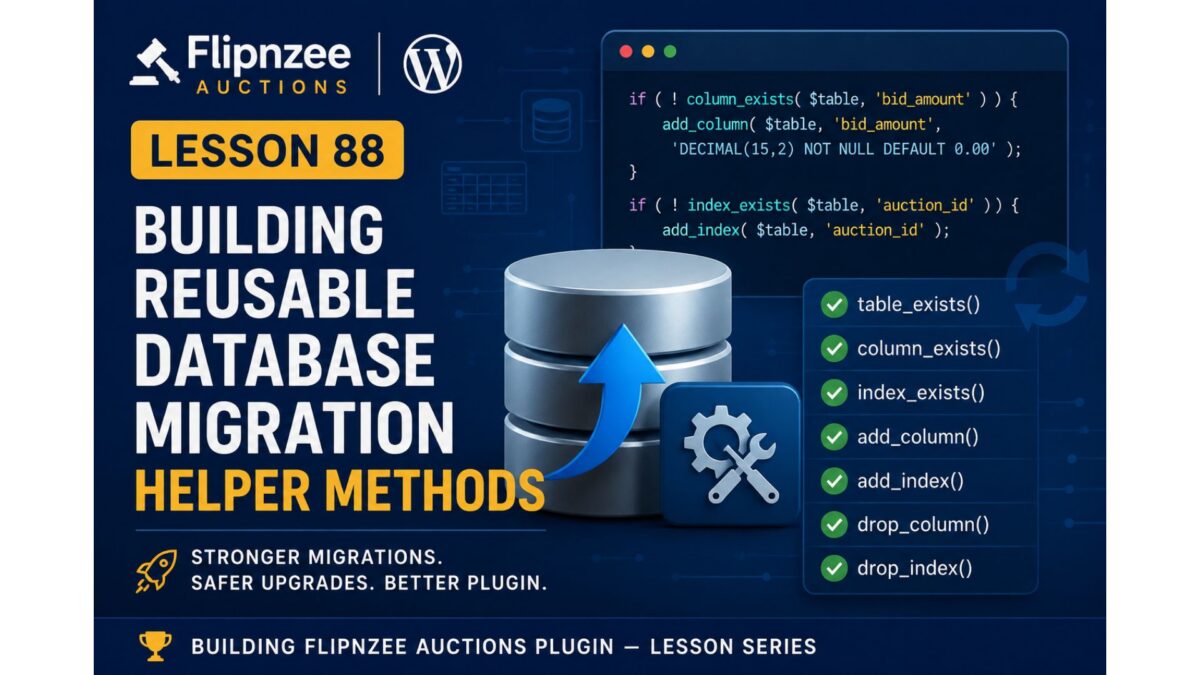
Lesson 88 Implementation: Building Reusable Database Migration Helper Methods

Series: Building the Flipnzee Auctions Plugin
Lesson: 88
Project: Flipnzee Auctions
Topic: Implementing Reusable Database Migration Helpers
Introduction
In Lesson 87, we introduced a dedicated database migration framework and integrated it into the plugin activation process. Although the migration runner was functional, it did not yet have the tools required to safely modify the database schema.
In this lesson, we implemented the first collection of reusable migration helper methods. These methods form the core toolkit that future database migrations will rely upon. Rather than repeatedly writing SQL existence checks and ALTER TABLE statements throughout the project, these common operations are now centralized inside the migration framework.
This represents another important architectural improvement for the Flipnzee Auctions plugin.
Objectives
The primary objectives for Lesson 88 were:
- Build reusable database helper methods.
- Reduce duplicate SQL logic.
- Improve migration safety.
- Prepare the framework for production database upgrades.
- Keep plugin activation stable throughout development.
Implementation Overview
During this lesson we extended the new migration framework by introducing reusable helper methods responsible for inspecting and modifying the database schema.
The migration framework now contains dedicated methods for:
- checking tables
- checking columns
- checking indexes
- safely adding columns
- safely adding indexes
These methods will become the building blocks for all future database migrations.
Files Modified
Migration Framework
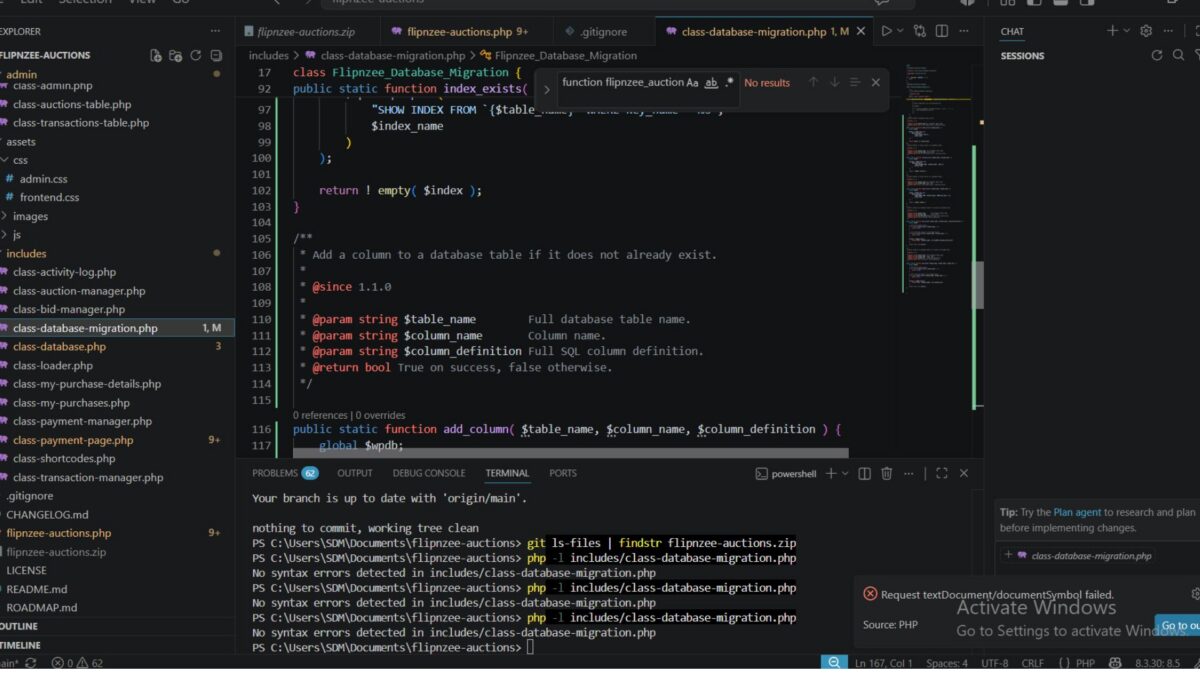
includes/class-database-migration.php
This file received the majority of the implementation work during this lesson.
No significant changes were required elsewhere because the migration framework had already been integrated during Lesson 87.
Helper Methods Implemented
table_exists()
Determines whether a database table exists before any migration attempts to modify it.
Responsibilities:
- verify table existence
- prevent unnecessary SQL errors
- support future migrations
column_exists()
Checks whether a column already exists inside a table.
This prevents duplicate column creation and allows migrations to be safely executed multiple times.
index_exists()
Determines whether a database index is already present.
This allows migrations to create indexes only when required.
add_column()
Introduced the first schema modification helper.
The method performs several checks automatically:
- verifies the table exists
- verifies the column does not already exist
- executes the
ALTER TABLEstatement only when appropriate
This significantly reduces repetitive migration code.
add_index()
Introduced a reusable helper for safely creating indexes.
Responsibilities include:
- checking table existence
- verifying the index does not already exist
- creating the index only when necessary
Future migrations can now add indexes using a single reusable method instead of duplicating SQL logic.
Current Migration Framework
The migration framework now provides the following structure:
Flipnzee_Database_Migration
│
├── run()
├── table_exists()
├── column_exists()
├── index_exists()
├── add_column()
└── add_index()
This toolkit establishes a consistent API for future database upgrades.
Architecture Benefits
The new helper methods provide several important advantages.
Reduced Code Duplication
Common SQL checks are now centralized.
Future migrations no longer need to repeatedly write:
SHOW TABLESSHOW COLUMNSSHOW INDEX- conditional
ALTER TABLEstatements
Improved Readability
Migration methods become significantly easier to understand.
Instead of embedding raw SQL throughout the codebase, migrations can simply call helper methods that clearly describe their intent.
Safer Database Upgrades
Each helper performs validation before executing SQL.
This reduces the likelihood of duplicate columns, duplicate indexes, or failed schema updates.
Easier Maintenance
Future enhancements to database handling can now be implemented in one location rather than throughout the plugin.
Testing
Each helper method was implemented incrementally and tested immediately after development.
The following checks were performed:
- PHP syntax validation
- plugin activation
- migration framework loading
- compatibility with existing installations
- activation stability
- no database regressions
The plugin activated successfully after each implementation step.
No activation warnings or database errors were encountered during testing.
Lessons Learned
Several software engineering principles continued to guide development during this lesson.
Build Infrastructure Before Features
Rather than immediately implementing production migrations, we first created a reliable toolkit that future migrations can depend upon.
Small Incremental Changes
Every helper method was implemented and tested individually.
This reduced debugging time and ensured plugin stability throughout development.
Reusability Improves Maintainability
Centralizing database operations inside reusable methods simplifies future development while reducing duplicated logic.
Separation of Responsibilities
The plugin architecture now clearly separates responsibilities.
Database Class
Responsible for:
- table creation
- installation
- database version management
Migration Class
Responsible for:
- migration runner
- schema inspection
- reusable migration helpers
- future database upgrades
This separation makes the project easier to maintain as it continues to grow.
Roadmap
With the helper library now in place, the migration framework is ready for real production use.
Lesson 89
The next lesson will introduce the first version-controlled database migration.
Planned objectives include:
- implementing the first production migration
- replacing manual schema upgrade logic
- using the new helper methods
- validating database version comparisons
- preparing the payment workflow for future enhancements
Git Milestone
A stable checkpoint was created after completing the migration helper library.
Commit
Lesson 88: Add reusable database migration helpers
Git Tag
lesson-88-stable
This tag marks another stable milestone in the evolution of the Flipnzee Auctions plugin.
Download the starting version of the plugin before the lesson:
Download the completed version after this lesson:
Conclusion
Lesson 88 focused on strengthening the internal architecture of the Flipnzee Auctions plugin by introducing a reusable migration helper library. Although these changes are largely invisible to end users, they significantly improve the quality and maintainability of the codebase.
With reusable helper methods now available, future database upgrades can be implemented using concise, consistent, and reliable migration code. This foundation prepares the project for production-grade version-controlled database migrations in the upcoming lessons and represents another important step toward building a robust WordPress auction marketplace plugin.