
Lesson 133: Refactoring the External Provider Manager

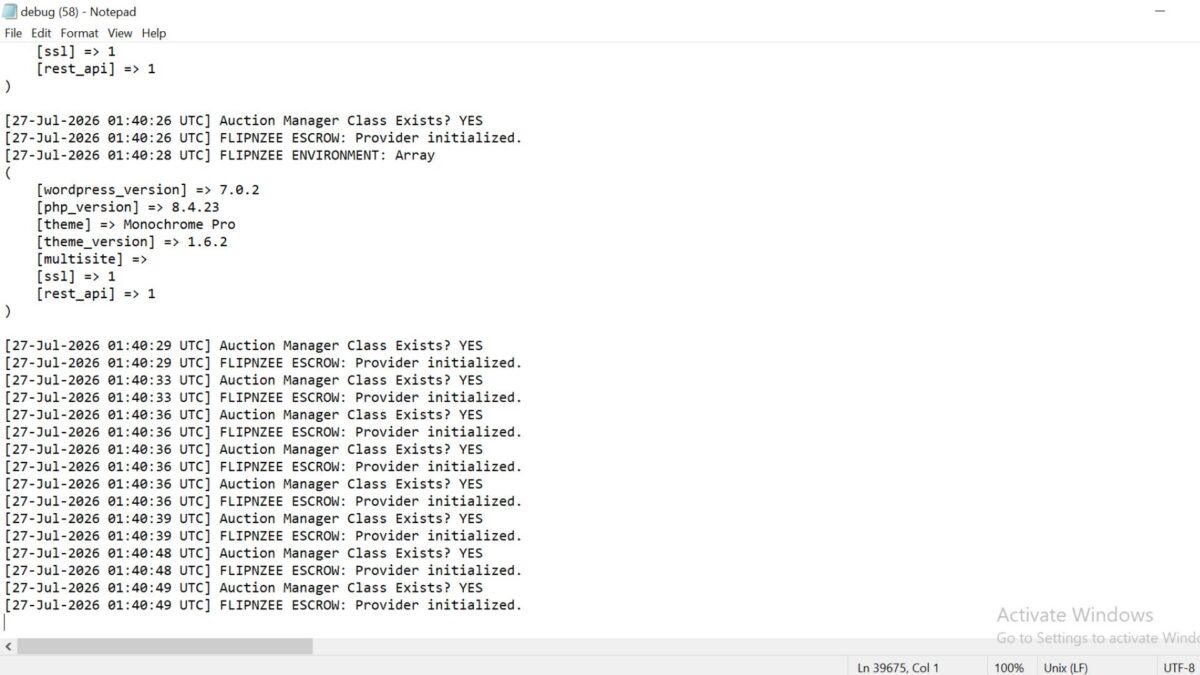
As Flipnzee Auctions continued to evolve, it became clear that the External Provider Manager was beginning to take on too many responsibilities. Earlier implementations mixed database operations, provider selection, and external API communication inside a single class. While functional, this made the code difficult to extend and harder to maintain.
In this lesson, the architecture was refactored so that each component has a single, well-defined responsibility. Although no new user-facing functionality was added, this refactoring lays the foundation for future integrations with Escrow.com and other external transaction providers.
Why This Refactor Was Needed
The original implementation blurred several different responsibilities:
- Creating local provider records.
- Communicating with external APIs.
- Updating provider metadata.
- Managing provider lifecycle.
As the Escrow integration matured, it became apparent that separating these concerns would produce cleaner, more maintainable code.
The objective of this lesson was not to change functionality, but to improve the plugin architecture.
New Responsibilities
The transaction workflow is now organized into distinct layers.
Transaction Manager
        │
        ▼
External Provider Manager
        │
        ▼
Escrow API Client
        │
        ▼
Escrow.com
Each layer now performs only one job.
Transaction Manager
Responsible for:
- Creating internal transactions.
- Creating local provider records.
- Building canonical transaction payloads.
- Coordinating provider synchronization.
External Provider Manager
Responsible for:
- Managing provider database records.
- Delegating API requests to the appropriate provider client.
- Synchronizing provider metadata.
It no longer performs HTTP requests directly.
Escrow API Client
Responsible for:
- Payload validation.
- API communication.
- Response normalization.
- Returning a standardized result to the application.
Provider Record Lifecycle
When a transaction is created, Flipnzee now creates an associated provider record before contacting the external provider.
The lifecycle is:
Create Transaction
        │
        ▼
Create Provider Record
        │
        ▼
Call Escrow API
        │
        ▼
Receive Response
        │
        ▼
Update Provider Record
This approach ensures every external transaction can be tracked independently from the auction transaction itself.
New Provider Synchronization
A new update_provider() method was introduced to synchronize provider information after receiving a successful response from the external provider.
Typical fields include:
- Provider reference
- Provider URL
- Current provider status
- Updated timestamp
This keeps the local database synchronized with the external provider without coupling database logic to the API client.
Improved Logging
Additional logging was added throughout the provider lifecycle.
Examples include:
- Provider record creation
- Provider synchronization
- Failed provider updates
- Database errors
These logs make debugging significantly easier during development and future integrations.
Cleaner Separation of Concerns
One of the biggest improvements introduced in this lesson is architectural rather than functional.
Instead of one large class handling everything, each class now has a clearly defined responsibility.
This makes it easier to:
- Add new payment providers.
- Replace existing providers.
- Unit test components individually.
- Extend the plugin without affecting unrelated functionality.
Current Status
While the External Provider Manager refactoring is now largely complete, testing also revealed that parts of the auction winner determination workflow require additional cleanup before the full transaction pipeline can be considered production-ready.
In particular, the reserve price validation logic inside the Bid Manager has accumulated duplicate and inconsistent code during previous iterations. Rather than layering additional features on top of unstable logic, the next lesson will focus on simplifying and stabilizing the winner determination process before continuing with further provider synchronization enhancements.
This is a good example of how software engineering often involves improving existing architecture before introducing new functionality. Careful refactoring at the right time helps keep a growing project maintainable and reduces the likelihood of subtle bugs appearing later as new features are added.
Lesson 133 demonstrates an important software engineering principle: clean architecture is an investment. By separating provider management, transaction orchestration, and external API communication into independent components, Flipnzee Auctions becomes easier to maintain today and significantly easier to extend in the future.