
Lesson 133: Persisting Provider References and Synchronizing Provider Status

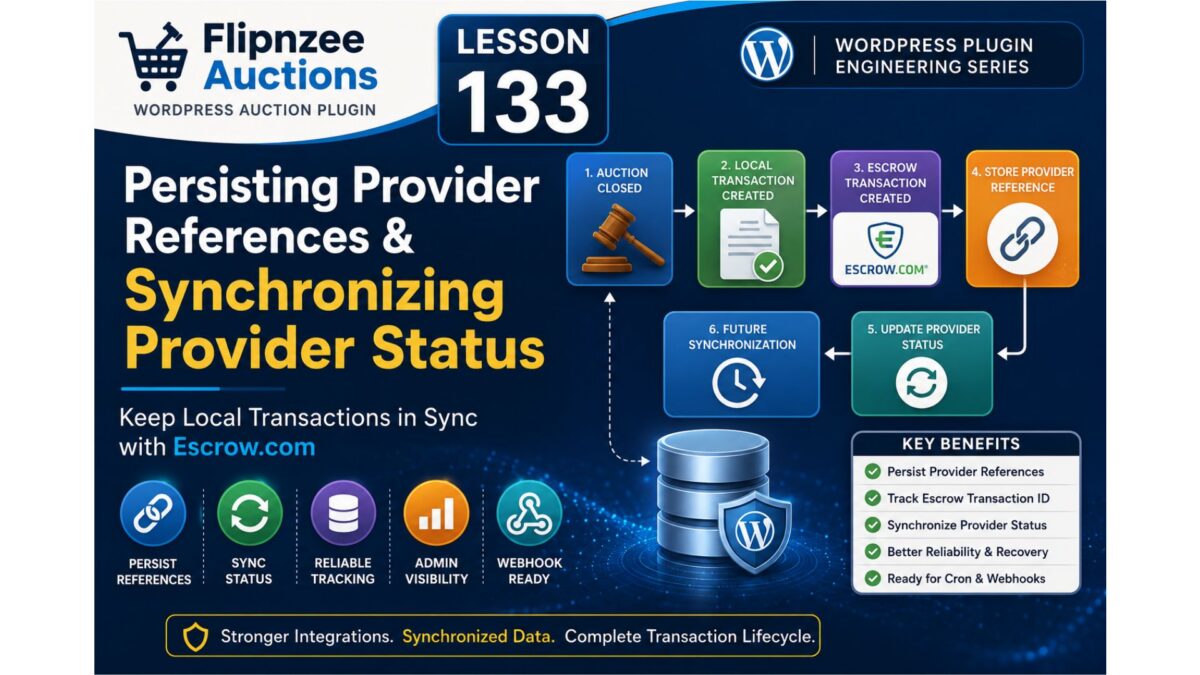
With the transaction payload standardized in Lesson 132, the Flipnzee Auctions plugin now has a consistent way to exchange transaction data between its internal components. The next step is ensuring that information returned by external providers is not lost.
Creating an Escrow transaction is only half of the process. Once the provider responds, the plugin should store the provider’s transaction reference, record its current status, and keep the local database synchronized with the external service.
Lesson 133 focuses on completing that connection.
Why this lesson is important
Until now, the transaction workflow has looked like this:
Auction Closed
      │
      ▼
Local Transaction Created
      │
      ▼
External Provider Record Created
      │
      ▼
Escrow API Request
      │
      ▼
Response Returned
Although the API returns useful information, much of it is not yet persisted for future use.
Without storing provider references, the plugin cannot reliably:
- Revisit an external transaction
- Check its latest status
- Display provider information in the admin area
- Recover gracefully after temporary API failures
The Goal
After this lesson, every successful provider transaction should immediately update the corresponding provider record.
The workflow becomes:
Auction Closed
      │
      ▼
Local Transaction
      │
      ▼
Create Provider Record
      │
      ▼
Escrow Transaction
      │
      ▼
Store Provider Reference
      │
      ▼
Update Provider Status
      │
      ▼
Future Synchronization
The provider record becomes the permanent link between Flipnzee Auctions and the external provider.
Provider Information to Store
When a provider successfully creates a transaction, the plugin should save information such as:
- Provider transaction reference
- Current provider status
- Provider transaction URL (when available)
- Last updated timestamp
- Synchronization notes
Persisting this information ensures that future API calls always know which external transaction they belong to.
Synchronizing Status
Rather than leaving every provider record in a generic “Pending” state, the plugin will begin recording the actual status returned by the provider.
Typical values may include:
- Created
- Awaiting Payment
- Payment Received
- In Progress
- Completed
- Cancelled
Using normalized status values makes the rest of the plugin independent of provider-specific terminology.
Strengthening the External Provider Manager
The External Provider Manager now evolves from simply forwarding API requests into coordinating provider lifecycle management.
Its responsibilities include:
- Sending provider requests
- Validating provider responses
- Saving provider references
- Updating provider status
- Returning standardized results to the Transaction Manager
This keeps provider-specific behavior isolated from the rest of the application.
Benefits
Persistent Transaction Tracking
Every auction remains permanently linked to its external provider transaction.
Better Administration
Administrators can identify provider transactions without manually searching the external platform.
Improved Reliability
If synchronization fails, the stored provider reference allows the plugin to retry later.
Foundation for Scheduled Synchronization
Saving provider identifiers prepares the plugin for future background status checks using WP-Cron.
Webhook Ready
Future webhook events can immediately identify the correct local transaction because the provider reference has already been stored.
Architecture After Lesson 133
Auction Closed
      │
      ▼
Transaction Manager
      │
      ▼
Canonical Transaction Payload
      │
      ▼
External Provider Manager
      │
      ▼
Escrow API Client
      │
      ▼
Persist Provider Reference
      │
      ▼
Synchronize Provider Status
      │
      ▼
Local Database
This completes the core transaction lifecycle by ensuring that local records remain connected to their corresponding external transactions.
What We Will Implement
During this lesson we will:
- Process successful responses returned by the Escrow API client.
- Persist provider transaction references in the database.
- Update provider status automatically after transaction creation.
- Store provider URLs when available.
- Record synchronization timestamps.
- Improve activity logging for provider creation and status updates.
- Prepare the architecture for future scheduled synchronization and webhook support.
What You’ll Learn
By completing Lesson 133, you’ll gain practical experience with:
- Synchronizing local records with external services.
- Designing reliable provider integrations.
- Persisting external identifiers for long-term tracking.
- Building extensible transaction workflows.
- Preparing a WordPress plugin for production-grade third-party integrations.
Next Lesson
Lesson 134 will introduce an External Provider Management screen within the WordPress admin area, allowing administrators to view provider records, monitor synchronization status, inspect provider references, and manage external transactions from a single dashboard.