
Lesson 132: Standardizing the Transaction Payload Across the Escrow Integration

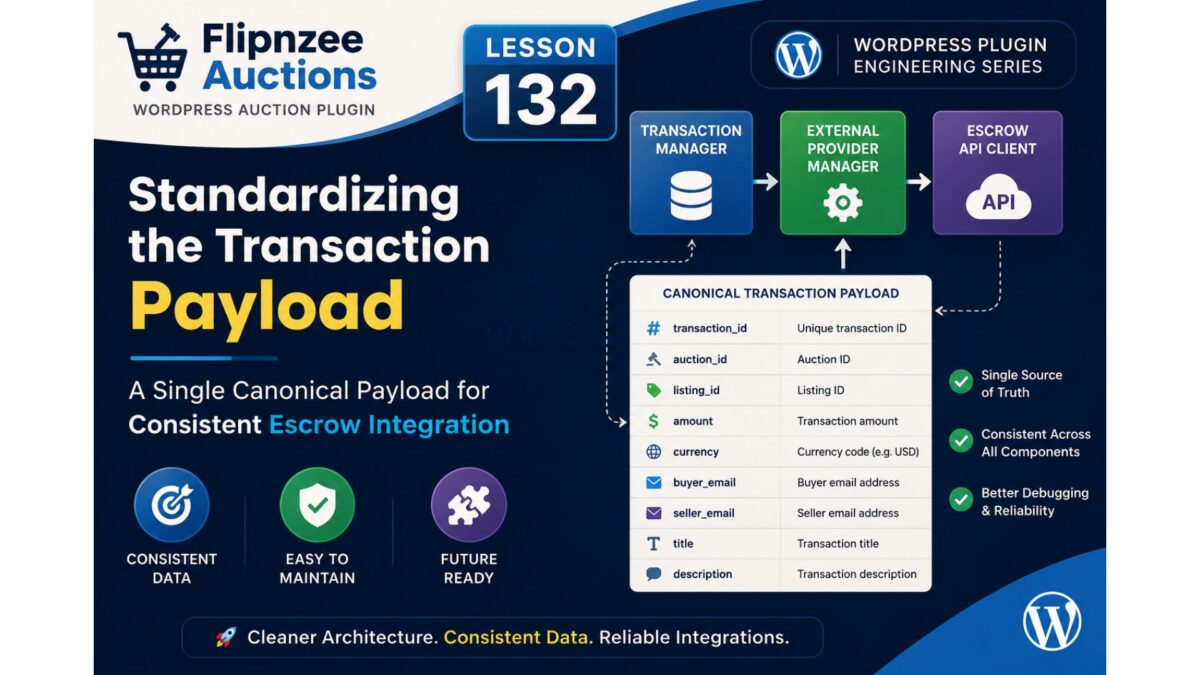
In the previous lesson, the External Provider Manager was introduced as an abstraction layer between the Flipnzee Auctions plugin and external payment providers. This significantly improved the architecture by separating transaction management from provider-specific logic.
During testing, however, another issue became apparent. Different components were building and consuming transaction data in slightly different formats. While the Transaction Manager, External Provider Manager, and Escrow API Client all exchanged arrays of data, they did not always agree on which fields should exist or what they should be called.
Lesson 132 focuses on solving this problem by introducing a canonical transaction payload.
The Problem
Prior to this lesson, each component expected slightly different data.
For example:
- Transaction Manager created transaction information.
- External Provider Manager rebuilt parts of the payload.
- Escrow API Client validated fields independently.
Although this worked in simple scenarios, it made debugging difficult because each layer could modify or recreate the transaction data.
The architecture looked like this:
Transaction Manager
        │
        ▼
Creates custom payload
        │
        ▼
External Provider Manager
        │
        ▼
Creates another payload
        │
        ▼
Escrow API Client
Every translation introduced another opportunity for inconsistencies.
The Solution
Lesson 132 introduces a single canonical payload structure that travels unchanged through the Escrow integration.
Instead of rebuilding arrays multiple times, the Transaction Manager becomes the authoritative source of transaction data.
The new workflow becomes:
Transaction Manager
        │
        ▼
Canonical Transaction Payload
        │
        ▼
External Provider Manager
        │
        ▼
Escrow API Client
Every component now speaks the same language.
Canonical Payload
The standardized transaction payload contains all information required by the provider layer.
Typical fields include:
- Transaction ID
- Auction ID
- Listing ID
- Amount
- Currency
- Buyer email
- Seller email
- Title
- Description
Rather than generating missing values later, these are prepared once and reused throughout the transaction lifecycle.
Benefits
Single Source of Truth
Transaction information is generated once and remains consistent throughout the workflow.
Easier Debugging
When an API request fails, developers can inspect one payload instead of tracing multiple array transformations across different classes.
Reduced Code Duplication
Provider managers no longer recreate values already available from the Transaction Manager.
Better Maintainability
Future changes to transaction fields require updates in only one location instead of several independent methods.
Improved Extensibility
Additional payment providers can consume the same payload without requiring provider-specific transaction builders.
This makes future integrations significantly easier.
Architectural Improvement
The transaction flow is now much cleaner.
Before:
Transaction Manager
        │
        ▼
Creates Payload A
        │
        ▼
External Provider Manager
        │
        ▼
Creates Payload B
        │
        ▼
Escrow API Client
After:
Transaction Manager
        │
        ▼
Canonical Transaction Payload
        │
        ▼
External Provider Manager
        │
        ▼
Escrow API Client
This removes unnecessary translation layers while making the integration easier to understand.
What We Will Implement
During this lesson we will:
- Define the canonical transaction payload.
- Refactor the Transaction Manager to construct the payload once.
- Remove duplicate payload construction from the External Provider Manager.
- Ensure the Escrow API Client consumes the standardized structure directly.
- Improve logging so the same payload can be traced throughout the entire transaction lifecycle.
What We’ll Learn
By the end of Lesson 132, you will understand:
- Why a canonical data structure simplifies software architecture.
- How to reduce coupling between components.
- How consistent data contracts improve debugging and maintenance.
- Why production-quality plugins rely on standardized payloads rather than ad hoc arrays.
Next Lesson
Lesson 133 will focus on persisting Escrow provider references and synchronizing provider status with local transactions, allowing the plugin to track external transaction identifiers and keep local records aligned with the provider throughout the transaction lifecycle.