
Lesson 85 Implementation: Building the Payment Infrastructure and Database Versioning System

As Flipnzee Auctions continues to evolve into a complete auction marketplace, maintaining the database safely across plugin updates becomes increasingly important. While WordPress provides the dbDelta() function for creating and updating database tables, real-world testing during development revealed that relying entirely on dbDelta() for schema upgrades can sometimes lead to unexpected behaviour across different environments.
In this lesson, the focus shifted from simply adding new payment-related database fields to designing a more reliable foundation for future database upgrades. Along the way, a challenging activation issue became an opportunity to investigate WordPress database migrations in greater depth.
Objectives
The primary objectives of this lesson were to:
- Extend the transactions table for payment processing.
- Introduce database schema versioning.
- Build the foundation for future database migrations.
- Improve the payment infrastructure.
- Resolve plugin activation issues.
- Prepare the plugin for safe future upgrades.
Features Implemented
During this lesson, several important improvements were completed.
1. Payment Database Foundation
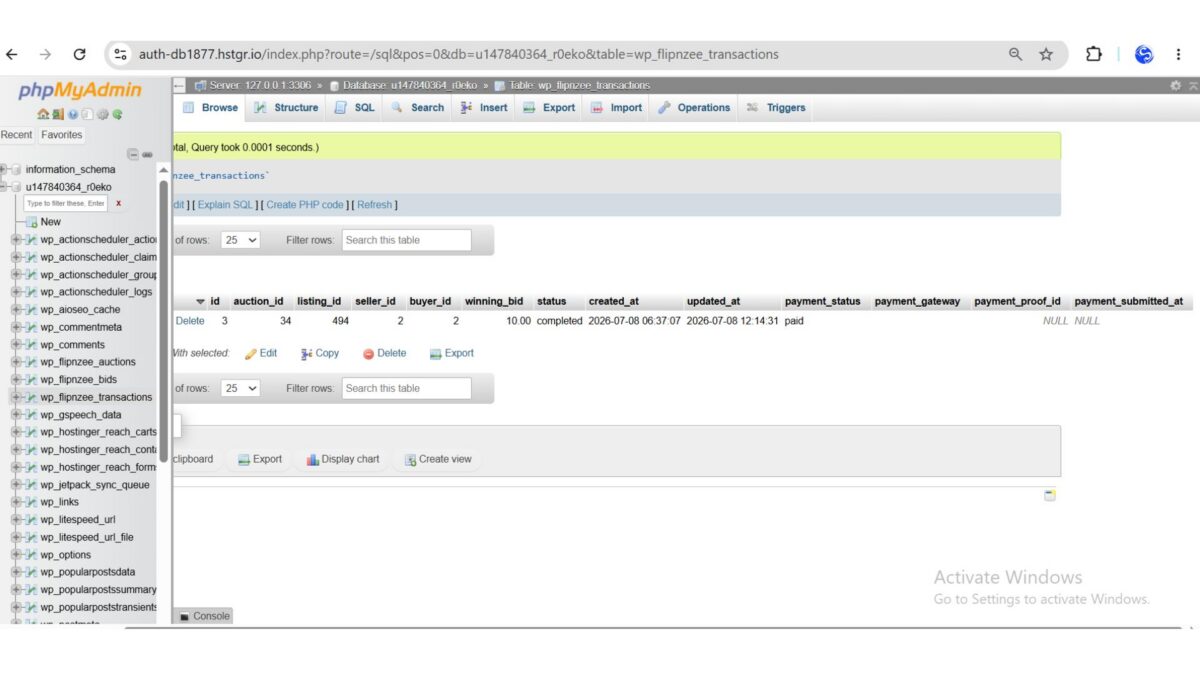
The transactions table was extended to support the upcoming payment workflow.
New database fields include:
payment_statuspayment_gatewaypayment_proof_idpayment_submitted_at
These fields provide the information required for buyers to submit payments and for sellers or administrators to verify them.
2. Database Schema Versioning
A dedicated database version constant was introduced:
define( 'FLIPNZEE_DB_VERSION', '1.1.0' );
Separating the plugin version from the database schema version lays the groundwork for future database migrations without affecting plugin functionality.
3. Database Version Tracking
A new helper method was added to store the installed schema version:
public static function update_db_version() {
    update_option( 'flipnzee_db_version', FLIPNZEE_DB_VERSION );
}
The activation routine now records the installed database version after creating or updating the database tables.
4. Payment Infrastructure
The lesson also introduced the initial payment management components, including:
- Payment Manager class
- Payment administration page
- Payment styling
- Supporting transaction updates
These components will be expanded in upcoming lessons as the complete payment workflow is implemented.
Debugging the Activation Issue
One of the most educational parts of this lesson involved diagnosing a difficult plugin activation problem.
Initially, activating the plugin generated thousands of characters of unexpected output.
Rather than immediately rewriting the implementation, the issue was investigated systematically.
The debugging process included:
- validating SQL syntax
- checking PHP syntax
- comparing generated SQL with the database
- examining table structures
- isolating
dbDelta()calls - reviewing activation hooks
- inspecting plugin output
- checking for whitespace before PHP opening tags
- analysing activation behaviour across multiple iterations
This systematic approach made it possible to eliminate several possible causes before identifying and correcting the underlying issues.
Lessons Learned
Several valuable engineering lessons emerged from this implementation.
Database migrations deserve careful planning
Although dbDelta() is extremely useful for initial table creation, upgrading existing database schemas requires additional care. Introducing database version tracking provides a much safer path for future enhancements.
Debugging should be systematic
Rather than changing multiple components simultaneously, isolating one potential cause at a time greatly reduced the complexity of diagnosing the activation issue.
Build infrastructure before features
Instead of rushing into the payment workflow itself, creating the supporting database and versioning infrastructure first will make future development significantly easier.
Testing Performed
The following tests were successfully completed:
- Plugin activation
- Database table verification
- Payment column creation
- Existing data preservation
- Database version storage
- Payment infrastructure integration
- Administrative page verification
- Transaction table verification
The plugin returned to a stable working state after the activation issue was resolved.
Complete Source Code
The implementation involved updates across several files, including:
flipnzee-auctions.php

includes/class-database.php

includes/class-payment-manager.php

includes/class-payment-page.php

includes/class-transaction-manager.php

includes/class-auction-manager.php

includes/class-shortcodes.php

admin/class-admin.php

admin/class-admin-payments.php

admin/class-admin-transaction-details.php

assets/css/admin.css
These changes collectively establish the foundation for payment processing and future database migrations.
What Comes Next?
With the payment infrastructure and database versioning now in place, the next lesson will focus on implementing the first stage of the buyer payment workflow.
Upcoming work will include:
- Payment submission interface
- Payment proof upload
- Transaction status updates
- Seller verification workflow
- Administrative payment approval
These features will build upon the infrastructure completed during Lesson 85.
Download Source Code
Download the starting version of the plugin before the lesson:
Download the completed version after this lesson:
Final Thoughts
This lesson demonstrates an important aspect of professional software development: sometimes the most valuable progress comes not from adding visible features, but from strengthening the architecture beneath them.
By introducing database versioning, expanding the payment schema, and carefully investigating a complex activation issue, Flipnzee Auctions is now built on a much stronger technical foundation. These improvements will make future enhancements easier to implement, safer to deploy, and more reliable for users as the project continues to grow.