
Lesson 86: Building Reusable Database Migration Helpers for Flipnzee Auctions

Introduction
As software evolves, database schemas inevitably change. New features often require additional columns, indexes, or even entirely new tables. While WordPress provides the powerful dbDelta() function for creating and updating database tables, relying exclusively on it for every schema modification can become increasingly difficult as a plugin grows.
During the previous lesson, we introduced database version tracking after resolving an activation issue caused by schema upgrade processing. With a stable versioning mechanism now in place, the next logical step is to build a reusable migration toolkit that simplifies future database upgrades.
Instead of writing repetitive SQL checks every time a new database change is needed, we’ll create a collection of helper methods that can safely determine the current database structure before making any modifications. This approach improves code readability, reduces duplication, and provides a reliable foundation for all future migrations.
Lesson Objectives
By the end of this lesson we will:
- Design a reusable migration helper system.
- Detect whether database tables already exist.
- Verify if specific columns are present.
- Check for existing database indexes.
- Create helper methods for adding new columns.
- Create helper methods for adding indexes safely.
- Prepare helper methods for removing obsolete columns and indexes when required.
- Build a maintainable migration framework that future lessons can reuse.
Why We Need Migration Helpers
Without reusable helpers, every database upgrade typically requires repeating the same pattern:
- Check if a table exists.
- Check whether a column already exists.
- Execute an
ALTER TABLEstatement. - Handle duplicate column errors.
- Repeat the same logic for every future schema change.
Over time this leads to:
- duplicated code
- inconsistent error handling
- difficult maintenance
- greater risk during plugin upgrades
A centralized migration helper solves these problems by keeping all schema-related logic in one place.
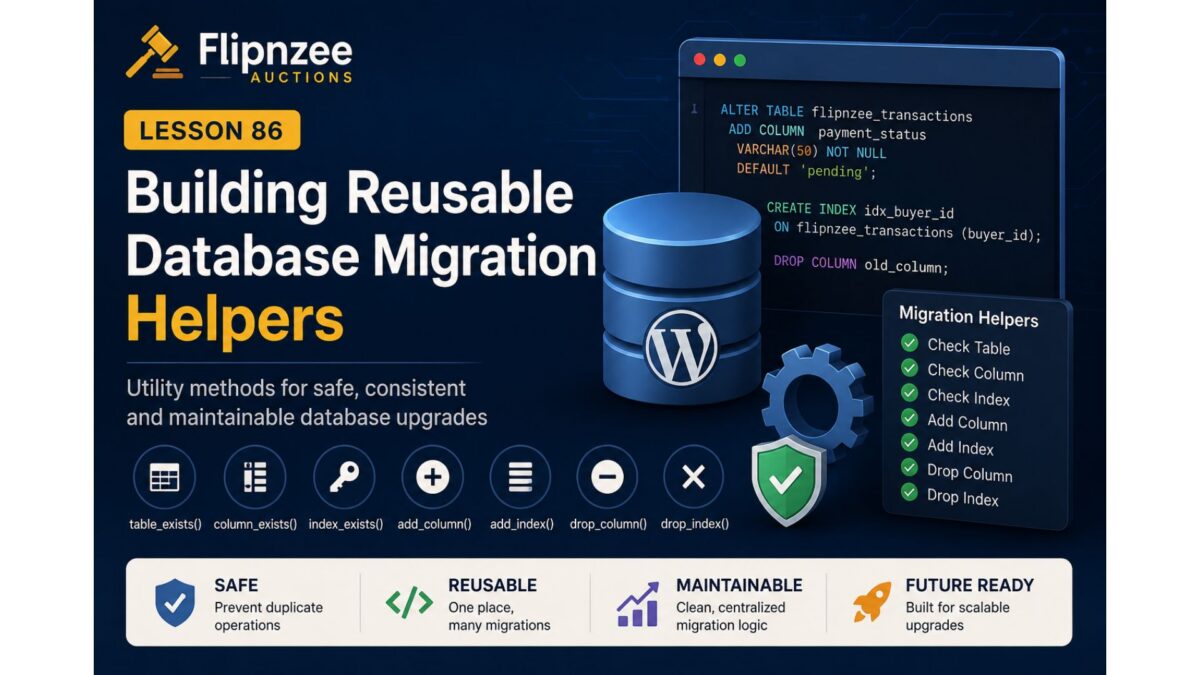
Planned Helper Methods
Our migration helper class will include several reusable methods.
table_exists()
Checks whether a database table currently exists before attempting any schema modifications.
Example use cases:
- verifying custom auction tables
- confirming transaction tables
- validating optional plugin components
column_exists()
Determines whether a specific column already exists within a table.
This prevents SQL errors such as:
Duplicate column name
Future migrations can safely execute only when the required column is missing.
index_exists()
Indexes improve query performance, but attempting to recreate an existing index results in SQL errors.
This helper allows migrations to safely verify whether an index already exists before adding it.
add_column()
Instead of repeatedly writing raw SQL throughout the project, this helper will:
- verify table existence
- verify column absence
- execute the required ALTER TABLE statement
- return a success/failure result
This greatly simplifies future migrations.
add_index()
Provides a standardized method for creating indexes while avoiding duplicate index errors.
Future performance improvements can be implemented with minimal code.
drop_column()
Although used less frequently, removing obsolete columns should follow the same controlled process.
This helper keeps removal operations consistent with additions.
drop_index()
Indexes occasionally become unnecessary after schema redesigns.
This helper provides a clean mechanism for safely removing outdated indexes.
Architectural Design
Rather than scattering migration logic across multiple files, we’ll centralize all reusable schema operations inside the database layer.
The migration helpers will serve as the foundation for future version-based migrations, allowing upgrade routines to focus only on what needs to change instead of repeatedly implementing how those changes should be performed.
This separation improves readability while making future maintenance significantly easier.
Benefits of Reusable Migration Helpers
Once implemented, future database upgrades become much cleaner.
Instead of writing repetitive SQL validation code for every release, migration scripts can simply invoke helper methods that already perform the necessary safety checks.
Advantages include:
- reduced code duplication
- safer database upgrades
- easier debugging
- improved readability
- better long-term maintainability
- simplified future development
Files Expected to Change
The implementation of this lesson is expected to modify the database management layer, including:
includes/class-database.php
Depending on the final architecture, additional migration-related classes or files may also be introduced if they improve organization without unnecessarily increasing complexity.
Testing Plan
After implementation we will verify that:
- helper methods correctly detect existing tables
- column detection functions return accurate results
- index detection works correctly
- duplicate columns are never created
- duplicate indexes are prevented
- existing databases continue functioning without modification
- fresh installations remain unaffected
Looking Ahead
With reusable migration helpers complete, the plugin will be ready for its first true production migration.
In the next lesson, we’ll replace the previous payment schema upgrade logic with a version-based migration that leverages these new helper methods. This will demonstrate how future database changes can be applied safely and consistently without relying on dbDelta() for incremental schema upgrades.
By taking this incremental approach, Flipnzee Auctions continues evolving toward a robust, production-quality architecture capable of supporting many future releases while maintaining backward compatibility with existing installations.
In the next step, we’ll implement the migration helper framework one method at a time, keeping the changes small, testable, and consistent with the project’s development philosophy.