
Lesson 89: First Production Database Migration

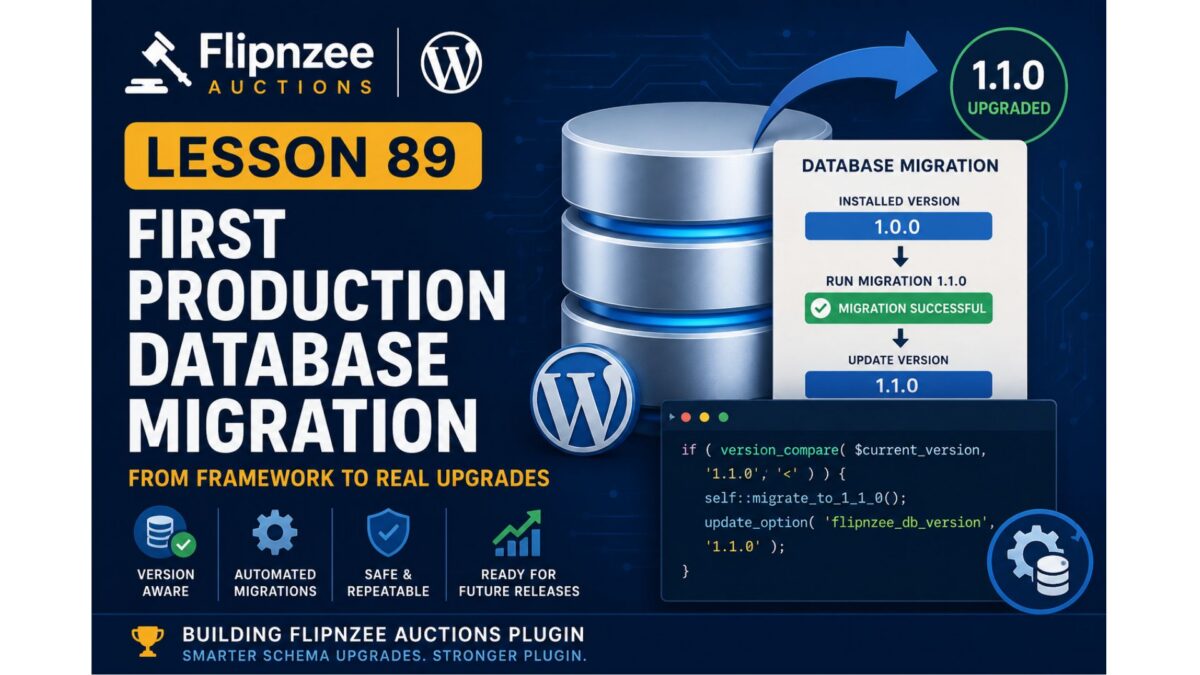
Series: Building the Flipnzee Auctions Plugin
Lesson: 89
Project: Flipnzee Auctions
Difficulty: Advanced
Introduction
Over the past several lessons, we have gradually transformed the Flipnzee Auctions plugin from using a simple database installation process into a structured, version-aware migration system.
The journey so far has been:
- Lesson 85 introduced database versioning.
- Lesson 86 stabilized plugin activation and separated fresh installations from existing upgrades.
- Lesson 87 created the database migration framework.
- Lesson 88 implemented reusable migration helper methods.
With the infrastructure now complete, we are finally ready to perform the first real production database migration.
This lesson marks an important milestone because the migration framework will begin performing actual schema upgrades rather than simply preparing for them.
Objectives
By the end of this lesson we will:
- implement the first production migration,
- perform version-based schema upgrades,
- use the migration helper methods,
- eliminate manual upgrade logic,
- validate database version comparisons,
- prepare the framework for future releases.
Current Architecture
Our migration framework currently contains:
Flipnzee_Database_Migration
│
├── run()
├── table_exists()
├── column_exists()
├── index_exists()
├── add_column()
└── add_index()
The framework exists, but the run() method currently does not execute any migrations.
Lesson Goal
Transform the migration framework from a passive structure into an active database upgrade system.
Planned Migration Flow
The migration runner will follow this process:
Plugin Activation
        │
        ▼
Read Stored Database Version
        │
        ▼
Compare Versions
        │
        ▼
Run Required Migration(s)
        │
        ▼
Update Database Version
Each migration should execute only once.
First Production Migration
The first migration will serve as the template for every future database upgrade.
Example concept:
Installed Version

1.0.0
      │
      ▼

Migration 1.1.0

      │
      ▼

Update Version

1.1.0
Future releases will simply extend this pattern.
Migration Philosophy
Rather than asking:
“Does my table match this SQL?”
the plugin will ask:
“What version is currently installed?”
This makes upgrades:
- deterministic,
- repeatable,
- maintainable,
- production friendly.
Planned Migration Method
This lesson is expected to introduce a dedicated migration function such as:
private static function migrate_to_1_1_0()
Responsibilities include:
- adding missing payment columns (if required),
- adding missing indexes,
- validating schema,
- ensuring idempotent execution.
The migration should safely execute regardless of whether the database is partially upgraded or already current.
Version Comparison
The migration runner will compare:
$current_version
against
FLIPNZEE_DB_VERSION
using:
version_compare()
Only migrations for newer versions should execute.
Example Flow
Stored Version

1.0.0

↓

Run Migration 1.1.0

↓

Update Version

1.1.0
If the stored version is already 1.1.0, the migration is skipped.
Files Expected to Change
Primary implementation:
includes/class-database-migration.php
Possible minor updates:
flipnzee-auctions.php
No changes are expected to class-database.php because installation and migration responsibilities are now separated.
Testing Strategy
After implementation we will verify:
- fresh installations,
- upgraded installations,
- repeated activations,
- version comparisons,
- migration execution,
- migration idempotency,
- database integrity,
- activation stability.
Each migration must be safe to execute multiple times.
Design Principles
During implementation we will continue following the same principles that have guided the project so far:
- one implementation step at a time,
- small reversible changes,
- systematic testing,
- stable Git checkpoints,
- WordPress Coding Standards,
- maintainable object-oriented architecture.
Future Migration Roadmap
Once the first production migration has been successfully implemented, future releases become straightforward.
1.2.0

↓

Escrow tables

↓

1.3.0

↓

Notification tables

↓

1.4.0

↓

Reporting tables

↓

1.5.0

↓

REST API enhancements
Each release simply introduces a new migration method.
Long-Term Benefits
Implementing production migrations provides several advantages:
- predictable upgrades,
- safer deployments,
- cleaner code,
- easier debugging,
- improved hosting compatibility,
- simplified future development.
The migration framework becomes the single source of truth for all database evolution.
Conclusion
Lesson 89 represents the transition from building migration infrastructure to actively using it. For the first time, the Flipnzee Auctions plugin will execute a controlled, version-aware database migration using the helper methods introduced in previous lessons.
This establishes the pattern that every future release will follow, allowing the plugin to evolve safely without relying on repeated dbDelta() schema comparisons. It is a major architectural milestone that moves Flipnzee Auctions closer to the standards expected of mature, production-quality WordPress plugins.