
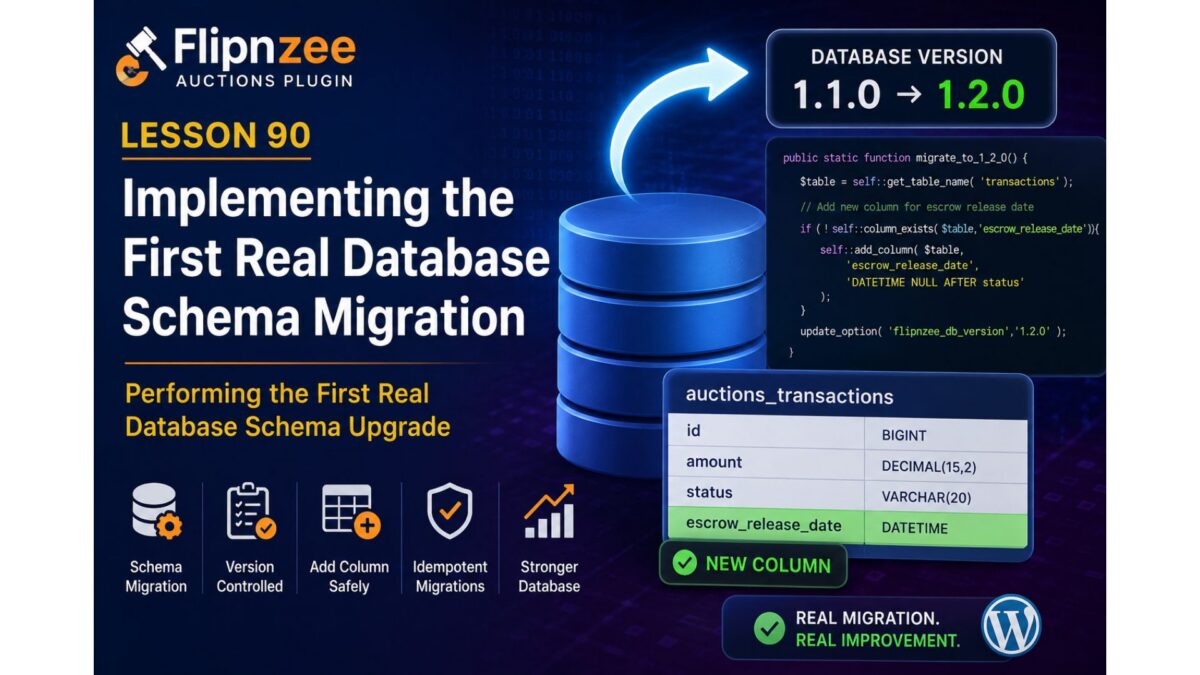
Lesson 90: Implementing the First Real Database Schema Migration

Series: Building the Flipnzee Auctions Plugin
Lesson: 90
Project: Flipnzee Auctions
Topic: Performing the First Real Database Schema Migration
Introduction
With the migration infrastructure now fully operational, the Flipnzee Auctions plugin is finally ready to perform its first real database schema upgrade.
In the previous lessons, we gradually built the migration architecture:
- Lesson 85 introduced database versioning.
- Lesson 86 stabilized plugin activation.
- Lesson 87 created the migration framework.
- Lesson 88 implemented reusable migration helper methods.
- Lesson 89 implemented the first version-controlled migration lifecycle.
Although Lesson 89 successfully executed version-aware migrations, the migration itself intentionally contained only placeholder logic. This allowed us to validate the framework without risking unintended database changes.
In Lesson 90, we take the next logical step by using the migration helper methods to perform the plugin’s first real schema modification.
Objectives
By the end of this lesson we will:
- implement the first production database schema migration,
- use the reusable migration helper methods,
- safely modify an existing database table,
- validate idempotent migrations,
- further reduce reliance on
dbDelta()for upgrades.
Why This Lesson Is Important
A migration framework has little practical value until it begins performing actual schema changes.
This lesson demonstrates that the framework is now capable of evolving the database safely over time.
Rather than rebuilding entire tables during activation, the plugin will perform only the required changes.
Current Migration Architecture
The plugin currently provides:
Plugin Activation
        │
        ▼
Migration Runner
        │
        ▼
Version Comparison
        │
        ▼
Migration Methods
        │
        ▼
Update Database Version
The framework is now ready to execute real database modifications.
Planned Migration
This lesson will implement the project’s first genuine schema migration.
The migration will use the helper methods introduced in Lesson 88 instead of writing raw SQL directly.
Example workflow:
Database Version

1.0.0

↓

Run Migration

↓

Check Table

↓

Check Column

↓

Add Column (if required)

↓

Update Database Version
Planned Schema Change
Rather than introducing a large structural change, we will begin with a small, safe migration.
Possible candidates include:
- adding a new transaction metadata column,
- adding a missing payment-related column,
- adding a new index to improve query performance.
The migration should be:
- backward compatible,
- idempotent,
- safe to execute multiple times.
Why Start Small?
Large schema migrations are difficult to debug and can increase deployment risk.
By introducing a single controlled change we can verify:
- migration helpers,
- version comparisons,
- schema validation,
- production upgrade workflow.
Once proven, future migrations become straightforward.
Files Expected to Change
Primary implementation:
includes/class-database-migration.php
Possible updates:
includes/class-database.php
(if obsolete helper methods are removed after migration validation)
Very little work should be required elsewhere.
Migration Helper Usage
The migration should use the helper methods created during Lesson 88.
Expected helpers include:
table_exists()

column_exists()

index_exists()

add_column()

add_index()
No raw ALTER TABLE statements should be scattered throughout the plugin.
Testing Plan
After implementation we will verify:
- plugin activation,
- database version comparison,
- migration execution,
- successful schema update,
- repeated activation,
- no duplicate columns,
- no duplicate indexes,
- no activation warnings,
- compatibility with existing installations.
Design Principles
Throughout implementation we will continue following the project’s established development philosophy:
- implement one change at a time,
- test after every step,
- avoid unnecessary rewrites,
- keep migrations idempotent,
- follow WordPress Coding Standards,
- write maintainable object-oriented code.
Long-Term Migration Strategy
Future releases will simply add new migration methods.
Example roadmap:
1.2.0

↓

Escrow database

↓

1.3.0

↓

Notifications

↓

1.4.0

↓

Reporting

↓

1.5.0

↓

REST API enhancements
Each migration remains independent and version-controlled.
Benefits
After completing Lesson 90, the Flipnzee Auctions plugin will achieve another significant architectural milestone.
Benefits include:
- first real production schema migration,
- reusable migration workflow,
- safer upgrades,
- easier maintenance,
- reduced database risk,
- cleaner version management.
Roadmap
✅ Lesson 85
Database versioning.
✅ Lesson 86
Activation stability.
✅ Lesson 87
Migration framework.
✅ Lesson 88
Migration helper methods.
✅ Lesson 89
First version-controlled migration lifecycle.
▶ Lesson 90 (Current)
First real database schema migration.
Upcoming Lessons
Lesson 91
- Remove duplicate helper methods from
class-database.php. - Complete the migration framework transition.
- Centralize all schema upgrade logic.
Lesson 92
- Payment workflow schema enhancements.
- Additional transaction fields.
- Migration validation improvements.
Expected Outcome
By the end of Lesson 90, the Flipnzee Auctions plugin will perform its first genuine database schema modification through the migration framework. This is the point where the migration architecture begins delivering practical value, demonstrating that future database evolution can be handled safely, incrementally, and predictably.
This lesson represents the transition from building migration infrastructure to actively using it for real production upgrades, bringing the plugin another step closer to a robust, enterprise-quality WordPress auction marketplace.