
Lesson 83 Implementation: Refactoring the Flipnzee Auctions Dashboard with Reusable Helper Methods

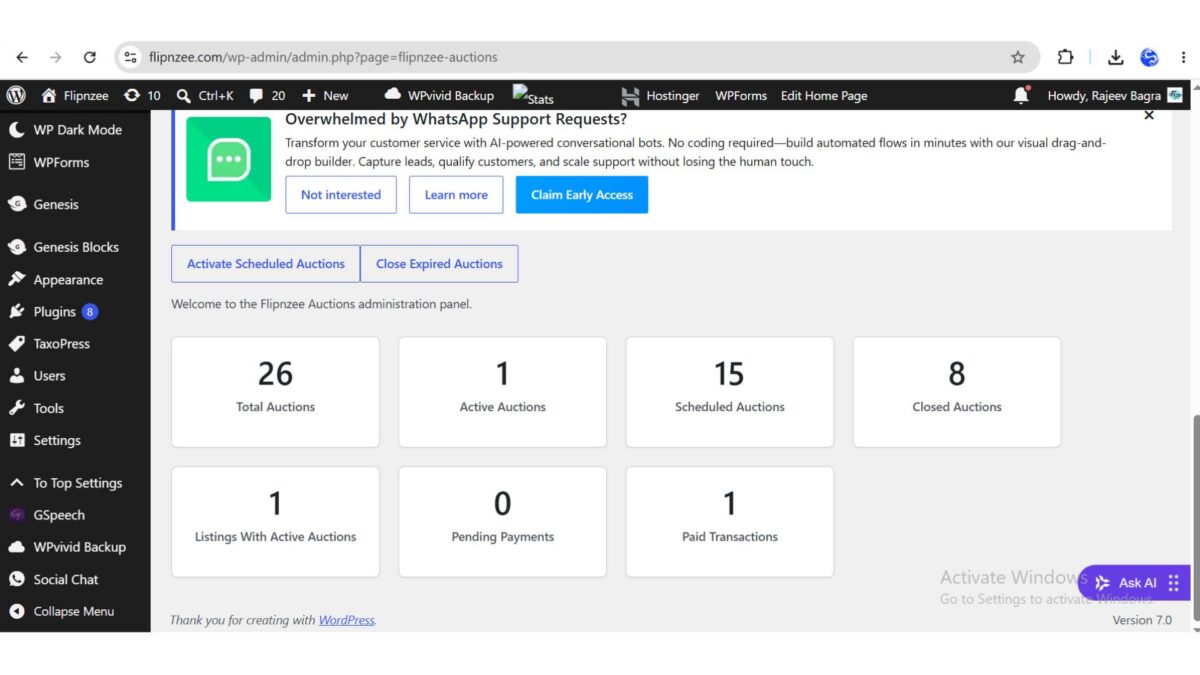
As the Flipnzee Auctions plugin continues to evolve, maintaining clean, readable, and reusable code becomes increasingly important. In previous lessons, the dashboard was enhanced to display multiple live statistics, including the total number of auctions, active auctions, scheduled auctions, closed auctions, and transaction counts. Although the functionality worked perfectly, the dashboard contained repeated HTML for every statistics card.
In this lesson, the focus shifted from adding new features to improving the internal architecture of the plugin. By extracting the repeated dashboard card markup into a reusable helper method, the code became cleaner, more modular, and easier to maintain without changing any existing functionality.
Objective
The primary objective of this lesson was to eliminate duplicated HTML from the Flipnzee Auctions Dashboard by introducing a reusable helper method responsible for rendering individual dashboard cards.
The implementation aimed to:
- Remove repeated dashboard card markup.
- Improve readability of the
dashboard_page()method. - Follow the DRY (Don’t Repeat Yourself) principle.
- Improve maintainability for future dashboard enhancements.
- Preserve all existing functionality.
Original Dashboard Implementation
Previously, the dashboard rendered every statistics card directly inside the loop.
foreach ( $cards as $title => $value ) :
?>

<div class="flipnzee-dashboard-card">

    <h2>
        <?php echo esc_html( $value ); ?>
    </h2>

    <p>
        <?php echo esc_html( $title ); ?>
    </p>

</div>

<?php endforeach; ?>
Although this approach worked correctly, the HTML structure was tightly coupled with the dashboard logic. Every new dashboard card required copying the same markup again.
Creating a Reusable Helper Method
To eliminate the duplicated HTML, a new private helper method was introduced inside the Flipnzee_Auction_Admin class.
/**
 * Render a dashboard statistic card.
 *
 * @param string $title Card title.
 * @param mixed  $value Card value.
 */
private function render_dashboard_card( $title, $value ) {
    ?>
    <div class="flipnzee-dashboard-card">

        <h2><?php echo esc_html( $value ); ?></h2>

        <p><?php echo esc_html( $title ); ?></p>

    </div>
    <?php
}
This helper method accepts two parameters:
- The title of the dashboard statistic.
- The value to display.
The method is responsible only for rendering a dashboard card, making it reusable throughout the plugin.
Simplifying the Dashboard Loop
With the helper method in place, the dashboard rendering logic became significantly cleaner.
Instead of repeating HTML inside the loop, each dashboard card is now generated by a single function call.
foreach ( $cards as $title => $value ) {

    $this->render_dashboard_card(
        $title,
        $value
    );

}
This reduced the size of the dashboard_page() method and clearly separated data preparation from presentation.
Benefits of the Refactoring
Although the appearance of the dashboard remained unchanged, the internal architecture improved considerably.
The advantages include:
- Cleaner dashboard code.
- Elimination of duplicated HTML.
- Easier maintenance.
- Easier future expansion.
- Improved readability.
- Better object-oriented structure.
- Greater consistency across dashboard components.
Adding a new dashboard statistic now requires only a new entry in the $cards array rather than duplicating HTML.
Implementation Challenges
During the implementation, several structural issues had to be resolved.
Correct Placement of the Helper Method
Initially, the helper method was inserted inside the dashboard_page() method, which caused PHP syntax errors.
The issue was resolved by placing the helper method outside dashboard_page() while keeping it inside the Flipnzee_Auction_Admin class.
Cleaning Up Leftover HTML
After replacing the repeated dashboard markup with the helper method, several leftover closing HTML tags from the original implementation remained.
These obsolete tags were removed to restore the correct HTML structure.
Avoiding Duplicate Methods
While moving the helper function, an accidental duplicate copy of the method was created.
The duplicate method was removed, leaving a single reusable implementation.
Verifying Syntax
After completing the refactoring, PHP’s built-in syntax checker was executed.
php -l admin/class-admin.php
Output:
No syntax errors detected in admin/class-admin.php
This confirmed the refactoring introduced no syntax errors.
Testing
Extensive testing was carried out after the refactoring.
Dashboard Statistics
The following dashboard cards displayed correctly:
- Total Auctions
- Active Auctions
- Scheduled Auctions
- Closed Auctions
- Listings With Active Auctions
- Pending Payments
- Paid Transactions
Dashboard Actions
Both dashboard maintenance buttons continued to function correctly.
- Activate Scheduled Auctions
- Close Expired Auctions
No behavioural changes were introduced.
Plugin Pages
Additional plugin pages were opened to verify that no unrelated functionality had been affected.
Successfully tested:
- Dashboard
- Add Auction
- All Auctions
- Transactions
- Payments
- Activity Log
- Edit Auction
All pages loaded successfully.
Lessons Learned
This lesson reinforced several important software engineering concepts.
- Refactoring is an essential part of software development.
- Cleaner code is easier to maintain than duplicated code.
- Helper methods improve readability.
- Following the DRY principle reduces maintenance effort.
- Separating presentation from business logic produces a better architecture.
- Syntax validation should always follow structural changes.
- Functional testing is equally important after refactoring.
Final Result
The Flipnzee Auctions Dashboard now uses a reusable helper method to render every statistics card.
The dashboard looks exactly the same to administrators, but internally the code is significantly cleaner, shorter, and easier to extend.
This refactoring provides a stronger architectural foundation for future dashboard enhancements, including additional statistics, widgets, notifications, charts, and reusable UI components.
Download Source Code
Download the starting version of the plugin before the lesson:
Download the completed version after this lesson:
Source Code Summary
The implementation included the following improvements:
- Created the
render_dashboard_card()helper method. - Replaced duplicated dashboard HTML with a reusable method call.
- Removed redundant markup.
- Corrected method placement within the class.
- Eliminated duplicate helper methods.
- Validated PHP syntax.
- Tested all dashboard functionality.
- Verified backward compatibility.
Conclusion
Not every improvement in a software project involves adding new functionality. Sometimes the most valuable progress comes from improving the quality of the existing code.
By extracting repeated dashboard card markup into a reusable helper method, the Flipnzee Auctions plugin now follows cleaner object-oriented design principles while maintaining exactly the same user experience. The result is a more maintainable, scalable, and professional codebase that will support future development much more effectively.