
Lesson 56 – Building a WordPress Hook-Based Auction Lifecycle

Why This Lesson?
In Lesson 55, we successfully automated the auction lifecycle.
Whenever active auctions are retrieved, the plugin now automatically detects expired auctions and updates their status to Closed.
The feature works correctly.
However, there is one limitation.
Only the Auction Manager knows that an auction has just been closed.
No other plugin can respond to that event.
As Flipnzee grows into an ecosystem of complementary plugins, we need a way for different plugins to communicate without becoming tightly coupled.
This is exactly what WordPress Actions and Filters were designed for.
Why Hooks Matter
Suppose in the future Flipnzee Analytics wants to know when an auction closes.
Without hooks, the Analytics plugin would need to modify the Auctions plugin directly.
That creates unnecessary dependencies.
Instead, the Auctions plugin can simply announce:
“An auction has just been closed.”
Other plugins can decide whether they care about that event.
Current Flow
Visitor
    │
    ▼
Auction Shortcode
    │
    ▼
Auction Manager
    │
    ▼
Update Expired Auctions
    │
    ▼
Database
Only the Auction Manager knows what happened.
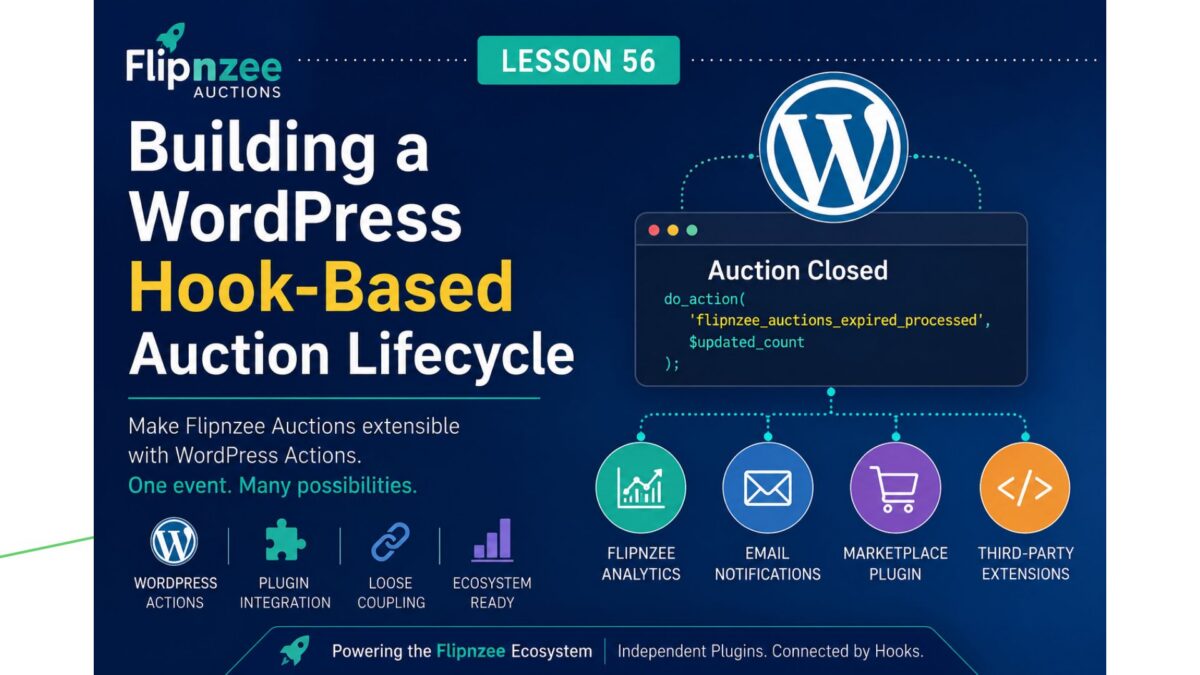
New Flow
Visitor
    │
    ▼
Auction Manager
    │
    ▼
Auction Closed
    │
    ├────────► Flipnzee Analytics
    │
    ├────────► Email Notifications
    │
    ├────────► Future Marketplace Plugin
    │
    └────────► Other Developers
Now the Auctions plugin becomes extensible.
What We’ll Build
Whenever one or more auctions are automatically closed, we’ll fire a WordPress action.
For example:
do_action(
    'flipnzee_auctions_expired_processed',
    $updated_count
);
or perhaps an even more descriptive hook if we process individual auctions in the future.
Initially, nothing else will listen to this action.
That’s perfectly fine.
We’re building the extension point first.
Why This Fits the Flipnzee Platform
Flipnzee Analytics should never need to edit the Auctions plugin.
Instead, it can simply listen for events such as:
- Auction Created
- Auction Updated
- Bid Placed
- Highest Bid Changed
- Auction Closed
- Winner Selected
Likewise, future plugins could react to the same events.
This keeps every plugin independent while allowing them to work together seamlessly.
Learning Objectives
In this lesson we will learn:
- WordPress Actions
- Plugin interoperability
- Loose coupling
- Designing extension points
- Building an extensible plugin architecture
Files Expected to Change
Most likely only:
includes/class-auction-manager.php
No database changes.
No UI changes.
No CSS changes.
Expected Behaviour
Today:
Auction closes
Tomorrow:
Auction closes

↓

WordPress Action Fires

↓

Other plugins can respond
Visitors won’t notice any visual difference, but the internal architecture becomes significantly more powerful.
Why This Before WP-Cron?
At first glance, WP-Cron might seem like the obvious next step.
However, even when we introduce background processing, we will still want other plugins to know that an auction has closed.
By creating the extension point first, the scheduled task can later reuse the same lifecycle events.
This results in cleaner, more reusable code.
Looking Ahead
This lesson prepares the way for future features such as:
- Scheduled auction processing (WP-Cron)
- Winner email notifications
- Seller notifications
- Marketplace statistics
- Analytics integration
- Activity logs
- Third-party extensions
Conclusion
Lesson 56 introduces one of the most important concepts in professional WordPress plugin development: building for extensibility.
Rather than treating Flipnzee Auctions as a standalone plugin, we begin designing it as part of the wider Flipnzee Platform, where independent plugins communicate through well-defined WordPress hooks instead of direct dependencies.
Why I changed the roadmap
I think this lesson is more valuable than jumping straight into WP-Cron because it establishes the architectural foundation first. When we later implement scheduled processing, email notifications, or deeper integration with Flipnzee Analytics, they’ll all be able to reuse the same hook system instead of requiring further refactoring.
This is exactly the kind of incremental, professional evolution we’ve been following throughout the project.