
Lesson 86 Implementation: Stabilizing Plugin Activation and Preparing the Migration Framework

Series: Building the Flipnzee Auctions WordPress Plugin
Lesson: 86
Project: Flipnzee Auctions
Difficulty: Intermediate–Advanced
Introduction
In the previous lesson, we laid the foundation for database versioning by introducing a database version constant and storing the plugin’s schema version inside WordPress. The long-term objective is to transition from relying solely on dbDelta() for database upgrades to a dedicated migration framework.
As work began on Lesson 86, the initial goal was to implement reusable migration helper methods such as table_exists(), column_exists(), index_exists(), and add_column(). However, during development we encountered a significant activation issue that required immediate investigation before continuing with the migration framework.
Rather than ignoring the problem and moving forward, we paused development to systematically isolate the root cause. This debugging effort ultimately resulted in a cleaner activation process and a more robust long-term architecture.
Objectives
The objectives for Lesson 86 were:
- Continue preparing the database migration system.
- Investigate unexpected plugin activation warnings.
- Restore stable plugin activation.
- Prevent unnecessary database schema comparisons during activation.
- Preserve the Lesson 85 database foundation.
- Prepare the project for the upcoming migration framework.
The Unexpected Activation Problem
During activation, WordPress displayed the following warning:
The plugin generated 11788 characters of unexpected output during activation.
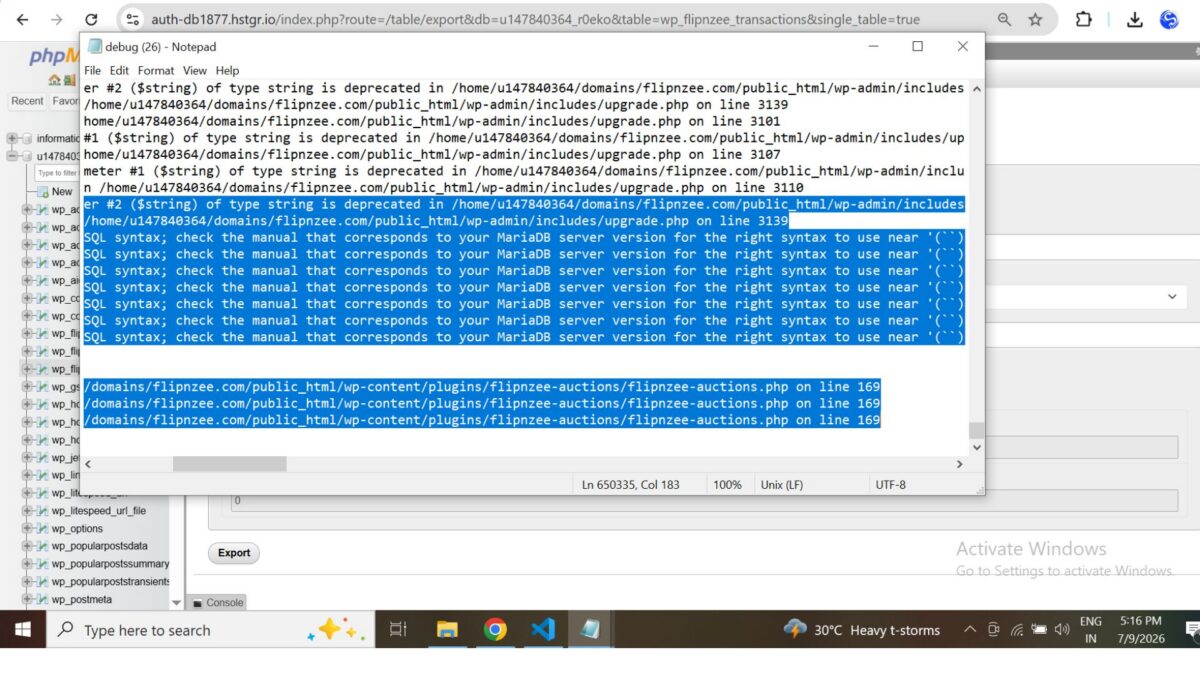
The debug log consistently pointed to WordPress core’s dbDelta() function, producing warnings similar to:
Undefined array key "index_name"
Undefined array key "index_columns"
Undefined array key "column_name"
followed by SQL such as:
ALTER TABLE wp_flipnzee_transactions ADD `` (``)
This SQL was not generated by the plugin itself. Instead, it originated from WordPress while attempting to compare the existing database schema with the SQL definition provided to dbDelta().
Debugging Strategy
Instead of making multiple unrelated changes, we followed a structured debugging process.
The investigation included:
- Verifying PHP syntax.
- Reviewing the transaction table schema.
- Inspecting the activation hook.
- Examining database exports.
- Comparing the SQL generated by the plugin.
- Reviewing WordPress debug logs.
- Comparing plugin behavior across different hosting environments.
- Restoring the project to the Lesson 85 Git checkpoint to confirm whether the issue originated in Lesson 86.
Each step narrowed the possibilities without introducing additional variables.
Cross-Environment Testing
One of the most valuable discoveries came from testing the exact same plugin on two different hosting environments.
WP Engine
- Plugin activated successfully.
- Database creation completed normally.
- No activation warnings appeared.
Hostinger
The same plugin triggered repeated dbDelta() parser warnings when reactivated on an existing installation.
This comparison demonstrated that:
- the plugin code itself was functional,
- the activation issue occurred during repeated schema comparisons on an existing database.
Architectural Improvement
Previously, the activation routine always executed:
Flipnzee_Auction_Database::create_tables();
This meant that every activation caused WordPress to run dbDelta() and compare the existing schema with the SQL definitions.
To avoid unnecessary schema comparisons, the activation logic was updated.
Previous implementation
function flipnzee_auction_activate() {

    Flipnzee_Auction_Database::create_tables();
    Flipnzee_Auction_Database::update_db_version();
}
Updated implementation
function flipnzee_auction_activate() {

    if ( false === get_option( 'flipnzee_db_version', false ) ) {
        Flipnzee_Auction_Database::create_tables();
    }

    Flipnzee_Auction_Database::update_db_version();
}
The revised activation process now creates database tables only during the initial installation. Existing installations simply update the stored database version and avoid unnecessary schema comparisons.
Why This Improvement Matters
This seemingly small change significantly improves the plugin architecture.
Instead of repeatedly asking dbDelta() to compare an already existing database schema, future upgrades will be handled by explicit migration routines.
Benefits include:
- faster activation,
- reduced risk of parser-related issues,
- cleaner upgrade path,
- easier maintenance,
- improved compatibility across different hosting environments.
Testing
The updated activation workflow was tested after correcting an unrelated PHP syntax issue introduced during debugging.
The final activation tests confirmed:
- ✅ Plugin activates successfully.
- ✅ Existing auction functionality remains operational.
- ✅ Payment infrastructure remains intact.
- ✅ Database version continues to update correctly.
- ✅ No activation warnings appear using the revised activation flow.
Git Checkpoint
After verifying successful activation, the project was committed and tagged as a stable checkpoint.
This provides a reliable rollback point before implementing the dedicated migration framework in future lessons.
Lessons Learned
Several important engineering lessons emerged from this debugging session.
1. Debug systematically
Avoid making multiple changes simultaneously. Isolating one variable at a time makes root causes much easier to identify.
2. Cross-environment testing is essential
Testing on multiple hosting providers revealed that the issue was environment-specific rather than a general plugin defect.
3. Stable checkpoints save time
Creating Git tags before major architectural changes allowed the project to be restored quickly during debugging.
4. Installation and upgrades are different concerns
Creating database tables and upgrading existing schemas should be treated as separate responsibilities.
Roadmap
The activation system is now stable again.
The next lessons will continue the original roadmap.
Lesson 87
Introduce a dedicated migration framework responsible for:
- version-based database upgrades,
- reusable migration helpers,
- controlled schema evolution,
- eliminating the need for repeated
dbDelta()schema comparisons on existing installations.
Download Source Code
Download the starting version of the plugin before the lesson:
Download the completed version after this lesson:
Conclusion
Although Lesson 86 began as an implementation of reusable migration helper methods, it evolved into an important architectural milestone.
By resolving the activation issues and refining the activation workflow, the Flipnzee Auctions plugin now has a more stable foundation for future database migrations. This work reinforces an important principle of long-term plugin development: installation and schema upgrades should be managed independently.
With a clean activation process restored and the database versioning system already in place, the project is well positioned to continue building a dedicated migration framework in the upcoming lessons.