
Lesson 129 – Simplifying Response Handling in the Escrow API Client

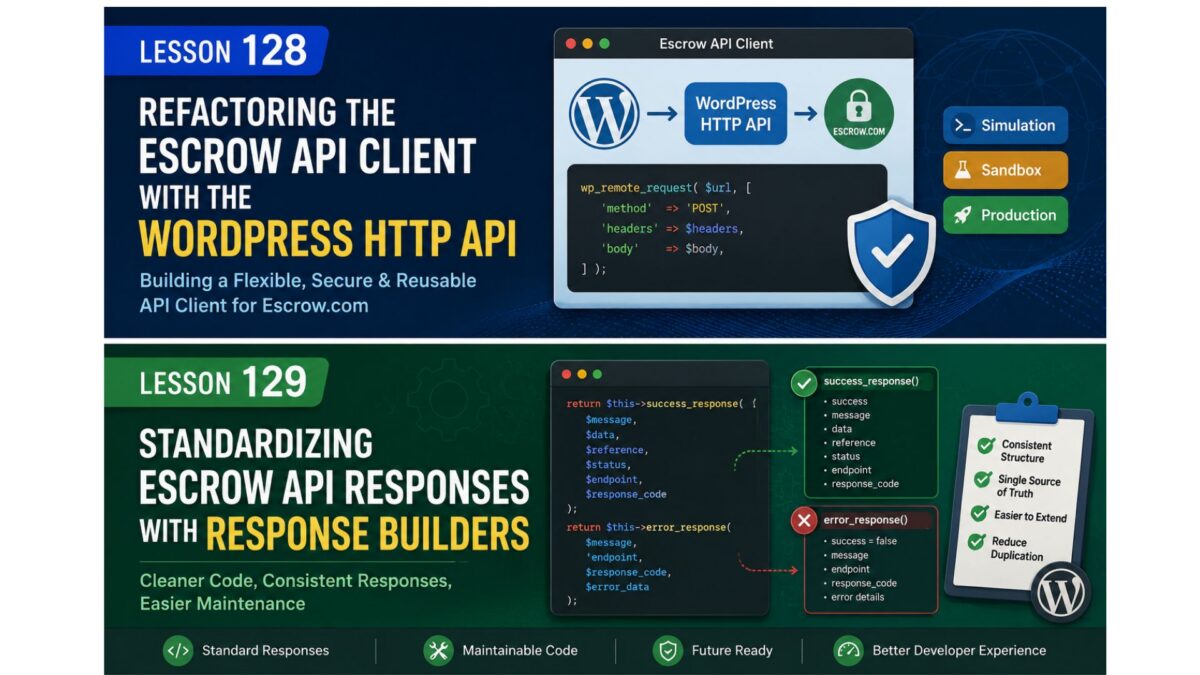
As Flipnzee Auctions continues to mature, one of the recurring goals is to reduce duplication while improving consistency across the codebase. After refactoring the Escrow API client in the previous lesson, we now have a centralized HTTP request layer built around the WordPress HTTP API.
Although that refactoring significantly improved the networking architecture, one area still contains unnecessary duplication: response construction.
In this lesson, we’ll simplify how the Escrow API client generates success and error responses.
Where We Left Off
Following the previous refactoring, every public method delegates its networking responsibilities to a reusable send_request() method.
The overall flow now looks like this:
Public Methods
        │
        ▼
send_request()
        │
        ▼
WordPress HTTP API
        │
        ▼
Escrow.com REST API
This removed duplicated networking logic and established a single entry point for all HTTP communication.
However, the responses returned by the client are still assembled in multiple places.
The Remaining Problem
Every interaction with the Escrow API ultimately returns a response array containing information such as:
- success status
- message
- transaction reference
- transaction status
- endpoint
- response code
- response data
While these arrays follow the same general structure, they are still created repeatedly throughout the client.
This duplication increases maintenance effort because every future change requires modifying several return statements instead of one centralized implementation.
Objectives of Lesson 129
The goal of this lesson is to centralize response creation while keeping the public interface of the Escrow API client completely unchanged.
By the end of this lesson:
- success responses will be generated consistently,
- error responses will follow the same structure,
- duplicated array construction will be removed,
- networking code will become easier to read,
- future enhancements will require fewer changes.
Separating Success and Error Responses
One useful design improvement is to clearly distinguish between successful operations and failed operations.
Rather than manually constructing response arrays throughout the client, we’ll introduce dedicated helper methods responsible for building standardized responses.
These helpers become the single source of truth for the response format used throughout the Escrow API client.
Benefits of Centralized Responses
Moving response construction into reusable helper methods provides several advantages.
Consistency
Every response—regardless of where it originates—shares the same structure.
This makes the client easier to consume throughout the plugin.
Maintainability
If new fields are added in the future, they only need to be implemented once.
For example, future enhancements might include:
- request identifiers,
- execution time,
- timestamps,
- provider metadata,
- debugging information.
Instead of modifying numerous return statements, these additions can be made within a single helper.
Readability
The networking logic becomes easier to understand because it focuses solely on:
- sending requests,
- processing responses,
- handling errors.
Constructing arrays is delegated to dedicated helper methods.
This separation makes the code significantly easier to follow.
Simulation Mode
Simulation mode remains an important part of the development workflow.
Rather than returning custom arrays directly, simulated responses will also use the new helper methods.
This ensures that simulation, sandbox, and production environments all produce responses with the same structure.
Maintaining identical response formats across environments simplifies testing and reduces the chance of environment-specific bugs.
Preparing for Future Features
A standardized response layer also provides a solid foundation for future Escrow integration features.
Upcoming lessons may introduce:
- live transaction creation,
- transaction updates,
- webhook processing,
- provider synchronization,
- enhanced diagnostics,
- detailed error reporting.
Having one centralized response format makes these enhancements considerably easier to implement.
Expected Outcome
After completing this lesson, the Escrow API client will return every success and failure through a consistent response mechanism.
The external behavior of the client will remain unchanged, but the internal implementation will be significantly cleaner, reducing duplicated code while improving maintainability and readability.
Conclusion
Good software architecture is often about removing repetition rather than adding new functionality.
By centralizing response handling, we’re making the Escrow API client simpler, more consistent, and easier to extend. This refactoring builds upon the improvements introduced in the previous lesson and prepares the client for the increasingly sophisticated payment features that will follow.
In the next lesson, we’ll implement this refactoring by introducing standardized success and error response helpers and updating the Escrow API client to use them throughout.
https://github.com/SplendidDigital/flipnzee-auctions/releases/tag/lesson-129-stable