Building Flipnzee Auctions – Lesson 112

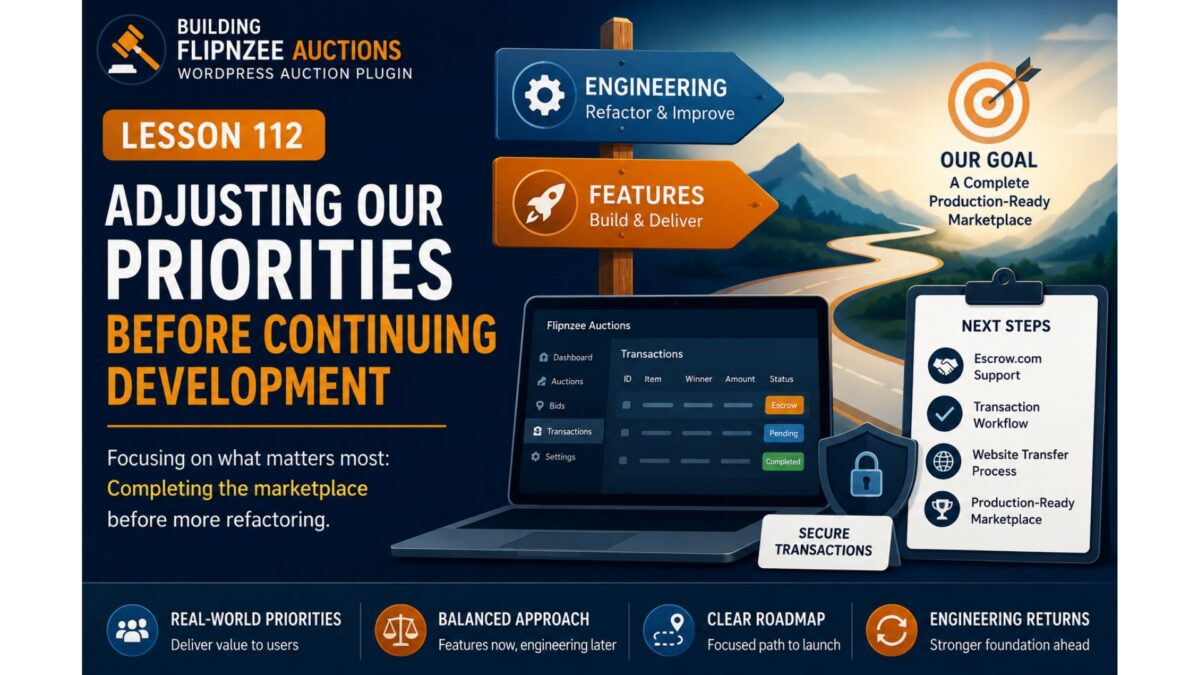
Adjusting Our Priorities Before Continuing Development
Series: Building Flipnzee Auctions
Lesson: 112
Difficulty: Beginner
Prerequisites: Lesson 111
Code Changes: None (Project Planning)
Introduction
Over the past several lessons, we’ve taken a short break from adding new features to review parts of the Flipnzee Auctions codebase from a software engineering perspective.
During that review, we examined the plugin bootstrap, explored the plugin lifecycle, and identified several areas that could eventually be improved through refactoring.
Our original intention was to continue along that path.
However, software projects rarely follow a perfectly straight roadmap.
Before continuing with additional engineering improvements, we’ve decided to return to feature development and complete one of the most important capabilities originally planned for Flipnzee Auctions: Escrow.com support.
Why Change Direction?
When this project began, Flipnzee Auctions was primarily a learning exercise for building a WordPress plugin.
As development progressed, it gradually evolved into a real marketplace application intended to power Flipnzee.com.
That changes the project’s priorities.
Instead of focusing solely on cleaner architecture, we now need to ensure that the marketplace itself is capable of supporting real transactions.
The Marketplace Is Almost Complete
Most of the core auction functionality already exists.
Today the plugin can:
- Create auction listings
- Accept bids
- Determine auction winners
- Manage transactions
- Display buyer information
- Support watchlists
- Record activity
- Handle administrative workflows
From a feature perspective, the marketplace is surprisingly close to being usable.
One important piece, however, is still missing.
The Missing Piece
Website and domain sales are often significantly more valuable than ordinary online purchases.
Because of that, buyers and sellers frequently prefer using a trusted third-party escrow service instead of sending money directly.
From the beginning of this project, Escrow.com was intended to become the primary payment method for completed auctions.
Although the plugin already contains the foundation for transaction management, the Escrow workflow itself has not yet been implemented.
Completing that workflow now provides more value than continuing with additional internal refactoring.
Engineering Is Not Being Abandoned
This is important.
We’re not abandoning the Plugin Engineering series.
We’re simply changing priorities.
Professional software projects constantly alternate between two activities:
Build New Features
        │
        ▼
Improve Existing Code
        │
        ▼
Build More Features
        │
        ▼
Refactor and Maintain
Both activities are important.
The challenge is deciding which one creates the greatest value at a particular stage of the project.
Right now, completing the marketplace is the higher priority.
Why Not Finish Refactoring First?
It might seem logical to finish every planned engineering improvement before adding more features.
In practice, that isn’t always the best approach.
Major features often influence the final architecture of a project.
Refactoring too early may result in restructuring code that will soon need to change again.
By completing the marketplace workflow first, future engineering decisions can be based on a more complete product.
What Happens Next?
The next phase of development returns to the Building Flipnzee Auctions series.
We’ll begin implementing the long-planned Escrow workflow, starting with a practical solution that can be used in production before exploring deeper integrations.
The immediate roadmap becomes:
Escrow.com Support
        │
        ▼
Transaction Workflow
        │
        ▼
Website Transfer Process
        │
        ▼
Production-Ready Marketplace
Once these marketplace features are complete, we’ll return to the Plugin Engineering series and continue improving the plugin’s architecture.
Key Takeaways
Software development is rarely a straight line.
As projects evolve, priorities naturally change.
Although we originally planned to continue refactoring the plugin, completing the marketplace now provides greater value for both the project and its future users.
The engineering work remains important—but the marketplace comes first.
Looking Ahead
In the next lesson, we’ll begin designing the Escrow.com payment workflow for Flipnzee Auctions.
Rather than jumping directly into API integration, we’ll first design a practical transaction process that allows buyers, sellers, and administrators to complete website sales securely while laying the foundation for future automation.
Why I prefer this version
This version doesn’t feel like an apology or a detour. Instead, it reflects a real-world product decision:
- Lessons 110–111 introduced engineering thinking.
- Lesson 112 explains why the project is returning to feature development.
- Lesson 113 onward resumes the familiar Building Flipnzee Auctions two-post format (planning first, implementation second).
That keeps both series coherent and makes the transition feel intentional rather than abrupt.