
Lesson 122: Persisting Escrow Provider Information for Future API Integration

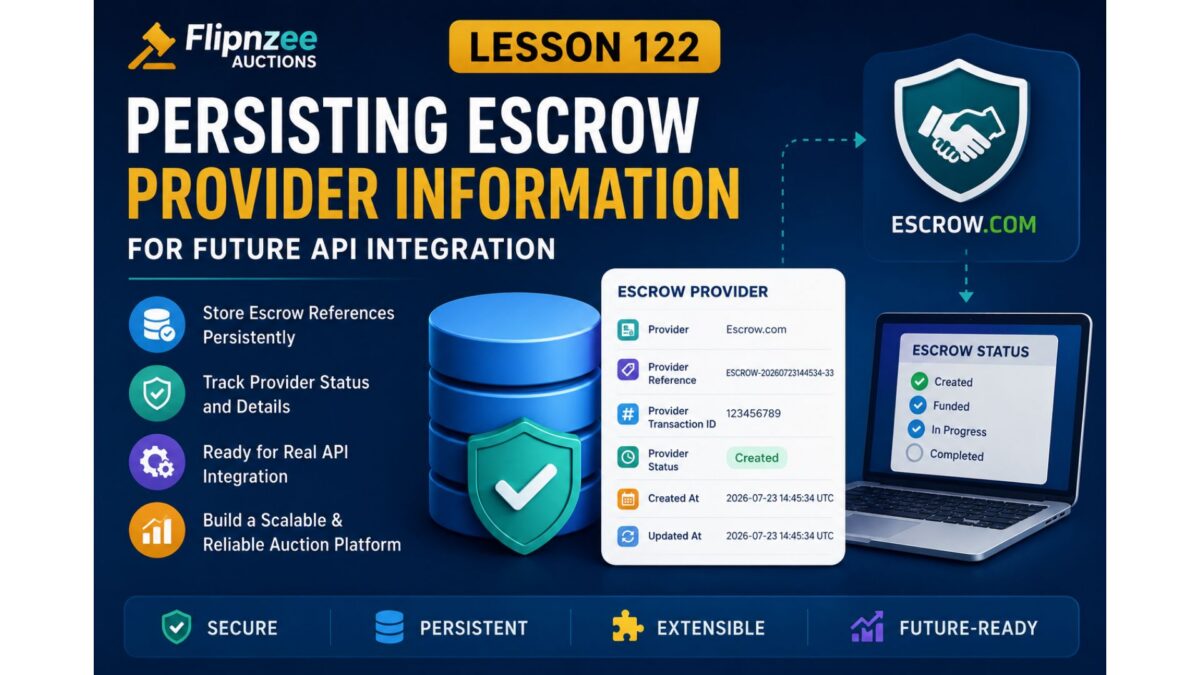
In the previous lesson, Flipnzee Auctions introduced its first Escrow Provider Engine. Payment completion automatically created a simulated escrow transaction and generated a unique escrow reference.
While that proved the event-driven architecture worked, the generated reference only existed during execution. Once the request finished, there was no permanent record of the escrow transaction.
In this lesson, the plugin takes the next step by designing a persistent storage strategy for external providers.
Why Store Escrow Information?
Real-world escrow services return much more than a reference number.
An external provider may return:
- Provider transaction ID
- Escrow reference
- Current escrow status
- Creation timestamp
- Last update timestamp
- API response details
- Provider-specific metadata
Without storing this information, the plugin would have no way to:
- check escrow progress
- synchronize status
- reopen existing escrow transactions
- display escrow details inside the admin panel
Persistence is therefore essential.
Objectives
By the end of this lesson the plugin architecture will support:
- persistent escrow references
- provider-specific transaction identifiers
- provider status tracking
- future API synchronization
- support for multiple external providers
Thinking Beyond Escrow.com
Although Flipnzee Auctions is initially designed around Escrow.com, the architecture should never assume only one provider exists.
Instead of storing fields like:
escrow_reference
escrow_status
the plugin adopts more generic terminology.
For example:
provider
provider_reference
provider_transaction_id
provider_status
This makes the database independent of any specific vendor.
Future providers could include:
- Escrow.com
- custom enterprise escrow
- regional payment escrow services
- internal manual escrow workflows
Extending the Transaction Model
The transaction lifecycle now grows beyond internal auction information.
Auction
        │
        ▼
Transaction
        │
        ▼
External Provider
        │
        ▼
Escrow Workflow
Instead of treating external services as an afterthought, they become a first-class component of the transaction architecture.
Recommended Provider Fields
A professional transaction record may eventually include:
| Field | Purpose |
|---|---|
| provider | Name of the provider |
| provider_reference | Human-readable reference |
| provider_transaction_id | External system ID |
| provider_status | Current provider status |
| provider_created_at | Provider creation time |
| provider_updated_at | Last synchronization |
| provider_response | Raw API response (optional) |
Not every provider will use every field, but the structure remains flexible.
Keeping Responsibilities Separate
The Transaction Manager remains responsible for:
- internal auction transactions
- payment information
- ownership workflow
The Escrow Provider becomes responsible for:
- creating provider records
- communicating with external APIs
- interpreting provider responses
- tracking provider-specific statuses
This clear separation keeps the plugin easier to maintain.
Future Synchronization
Creating an escrow transaction is only the beginning.
Eventually the plugin should support periodic synchronization.
Escrow Created
        │
        ▼
Store Provider Details
        │
        ▼
Scheduled Status Check
        │
        ▼
Retrieve Latest Status
        │
        ▼
Update Local Database
This enables administrators to see real-time escrow progress without manually checking the provider website.
Benefits of Persistent Storage
Persisting provider information allows administrators to:
- search escrow transactions
- troubleshoot failed payments
- view escrow references
- synchronize provider status
- audit completed transactions
- generate financial reports
These capabilities become increasingly valuable as transaction volume grows.
Preparing for API Integration
Most modern payment and escrow APIs follow a similar lifecycle:
- Create transaction
- Receive external reference
- Store the response
- Poll or receive status updates
- Finalize the transaction
Because Flipnzee Auctions now separates provider logic from transaction logic, integrating a live API becomes a matter of implementing provider-specific communication rather than rewriting the auction system.
Architectural Benefits
This lesson strengthens several important software engineering principles:
- Separation of concerns
- Single responsibility
- Provider abstraction
- Extensibility
- Maintainability
By treating external providers as independent services, the plugin becomes easier to evolve as new payment technologies emerge.
What We Accomplished
In this lesson we:
- designed a persistent model for external provider information
- separated provider data from transaction data
- prepared the database for long-term escrow tracking
- laid the groundwork for status synchronization
- ensured future provider integrations remain modular
- continued evolving Flipnzee Auctions into a production-ready architecture
Looking Ahead
With provider persistence planned, the next stage is to build the synchronization layer that keeps local transaction records aligned with external escrow providers.
This will allow Flipnzee Auctions to automatically monitor escrow progress, refresh statuses, and provide administrators with an accurate, real-time view of every transaction without relying on manual updates.