
Lesson 122: Persisting External Provider Transactions for Future Escrow Integration

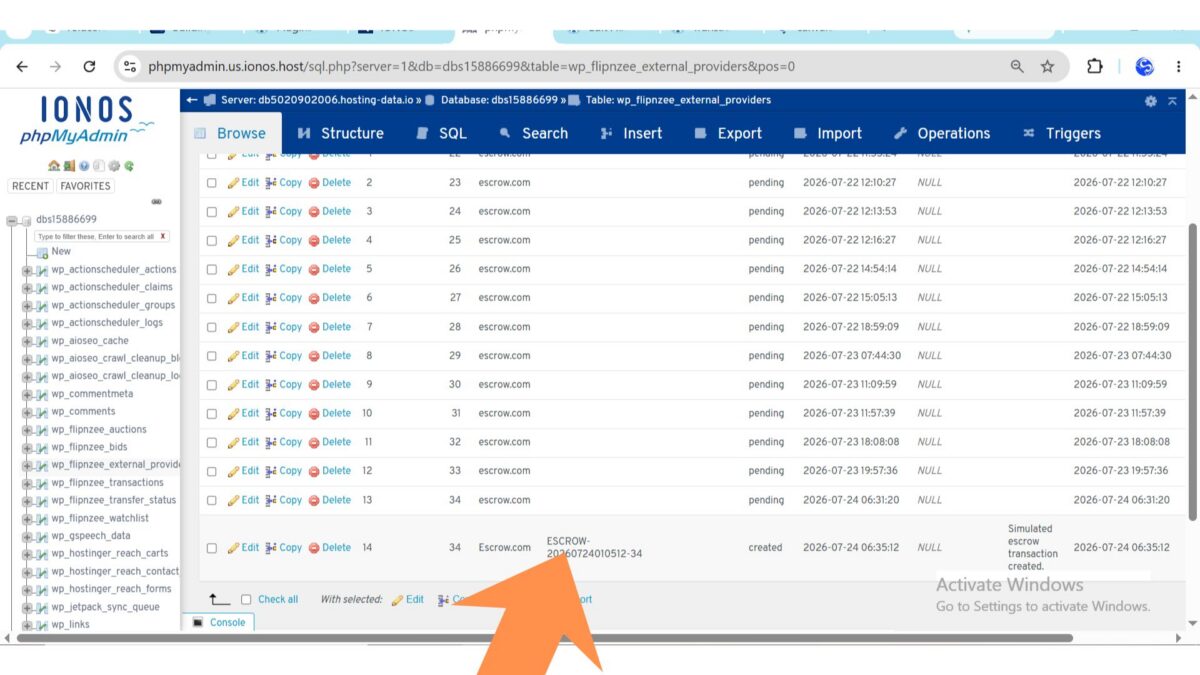
One of the goals of the Flipnzee Auctions project is to build a transaction system that can eventually integrate with multiple payment and escrow providers without requiring major architectural changes. While previous lessons introduced a simulated Escrow.com provider and an event-driven transaction lifecycle, provider information existed only temporarily during execution.
In this lesson, that changes.
Instead of simply generating a simulated escrow reference and returning it to the caller, the plugin now persists provider information in a dedicated database table. This transforms the provider layer from a simple simulation into a permanent part of the transaction history and prepares the architecture for future integration with real external services.
Why Persist Provider Information?
During a real website sale, the auction transaction is only one part of the process. Once payment is initiated through an external provider such as Escrow.com, additional information must be tracked independently of the auction itself.
Examples include:
- External provider name
- Provider transaction reference
- Provider status
- Processing timestamps
- Notes and audit information
Without persistent storage, all of this information would be lost once the request finishes.
Existing Provider Infrastructure
Earlier lessons already introduced a dedicated database table for external providers.
This lesson focuses on using that infrastructure rather than redesigning it.
Each provider record is linked to a Flipnzee transaction while maintaining its own independent lifecycle.
This separation keeps the auction system independent from the implementation details of any individual payment provider.
Enhancing the Escrow Provider
The simulated Escrow provider has been significantly expanded.
Instead of only generating an escrow reference, it now performs a complete provider workflow:
- Starts the provider transaction.
- Generates a unique simulated escrow reference.
- Creates a persistent provider record.
- Records timestamps and status.
- Returns the generated reference to the transaction lifecycle.
Conceptually, the workflow now looks like this:
Payment Completed
        │
        ▼
Transaction Lifecycle Manager
        │
        ▼
Escrow Provider
        │
        ├── Generate Escrow Reference
        ├── Create Provider Record
        ├── Store Status
        ├── Store Notes
        └── Return Reference
Persistent Provider Records
Every completed payment now creates a record similar to:
| Field | Example |
|---|---|
| Transaction ID | 34 |
| Provider | Escrow.com |
| Provider Reference | ESCROW-20260724010512-34 |
| Status | created |
| Started At | 2026-07-24 06:35 |
| Completed At | NULL |
| Notes | Simulated escrow transaction created. |
Unlike previous lessons, this information now survives beyond the lifetime of the PHP request and becomes part of the permanent transaction history.
The Role of the External Provider Manager
The Flipnzee_External_Provider_Manager acts as the persistence layer between business logic and the database.
Its responsibilities include:
- Creating provider records
- Retrieving provider information
- Updating provider status
- Looking up providers by transaction
- Removing provider records if necessary
By centralizing these operations, the Escrow provider no longer communicates directly with the database.
This follows the same architectural principle used throughout the plugin, where managers coordinate data access while providers focus on provider-specific behaviour.
Improved Logging
The provider workflow now produces much more meaningful debug output.
Typical logs now include messages such as:
FLIPNZEE ESCROW: Starting escrow transaction for transaction #34

FLIPNZEE EXTERNAL PROVIDER: create_provider() called.

FLIPNZEE EXTERNAL PROVIDER INSERT SUCCEEDED

FLIPNZEE ESCROW: Provider record #14 created.

FLIPNZEE ESCROW: Escrow reference ESCROW-20260724010512-34 created.
These logs make it considerably easier to diagnose provider-related issues during development.
Benefits of the New Architecture
Persisting provider information provides several advantages:
- Permanent audit trail of provider activity.
- Separation between auction transactions and external services.
- Easier debugging through structured provider records.
- Foundation for future status synchronization.
- Support for multiple providers without changing the auction model.
- Cleaner object-oriented architecture.
Most importantly, the auction plugin no longer treats provider interactions as temporary events—they are now first-class entities within the transaction system.
Looking Ahead
Although the current implementation still simulates Escrow.com, the surrounding architecture is now remarkably close to supporting a real integration.
Future lessons will build upon this foundation by:
- Displaying provider information within the Transaction Details screen.
- Updating provider status as transactions progress.
- Synchronizing with external provider APIs.
- Supporting additional payment providers using the same abstraction layer.
- Introducing webhook-based status updates.
With persistent provider records now in place, the Flipnzee Auctions plugin has taken another important step toward becoming a production-ready digital asset marketplace capable of handling complex website sale transactions in a clean, extensible, and maintainable manner.