
Lesson 128 – Refactoring the Escrow API Client with the WordPress HTTP API

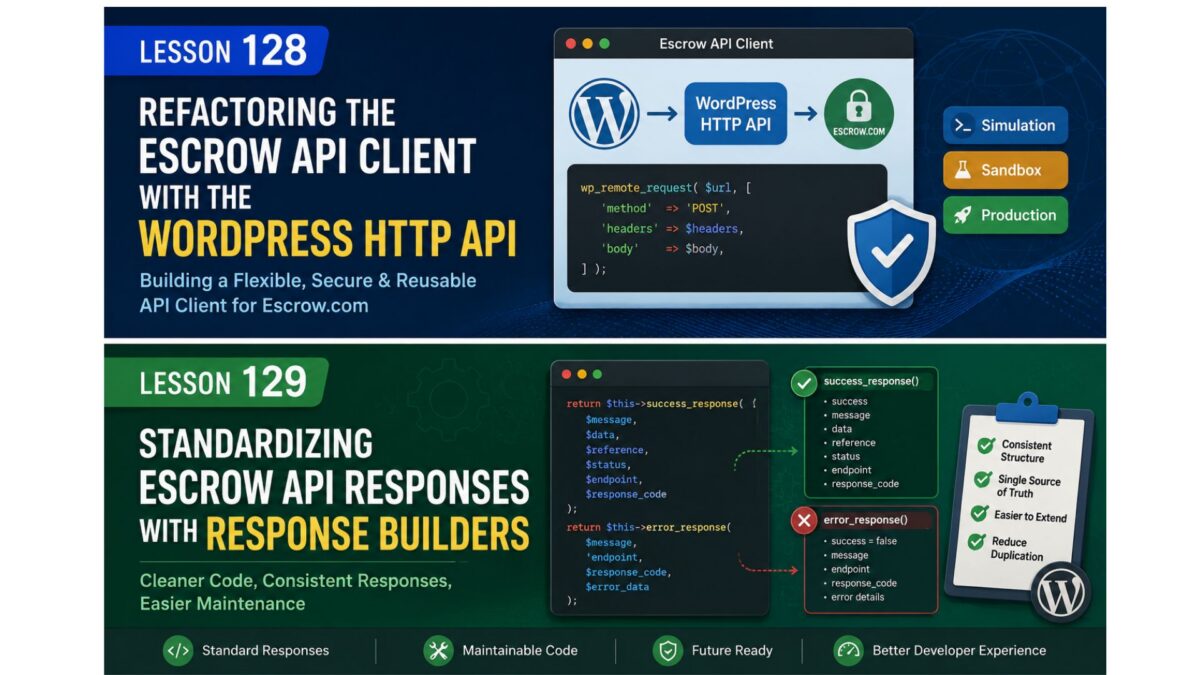
As Flipnzee Auctions continues to evolve from a learning project into a production-ready WordPress plugin, it’s important to periodically pause feature development and improve the underlying architecture.
Our current Escrow API client has served its purpose well by simulating API interactions, allowing us to build and test the payment workflow without relying on external services. However, before integrating with the real Escrow.com API, the client needs to be redesigned into a reusable, maintainable networking component.
In this lesson, we’ll plan that refactoring.
Where We Stand
The current Escrow API client already provides:
- Simulation mode for development
- Basic transaction creation methods
- Transaction status retrieval
- Connection testing
- Integration with the Escrow settings page
While functional, much of the networking logic is still tightly coupled to individual methods.
This makes future enhancements more difficult.
Current Limitations
Some of the issues with the existing implementation include:
- API logic duplicated across multiple methods.
- No centralized HTTP request handler.
- Environment handling mixed with business logic.
- Authentication generated in several places.
- Difficult to extend for future API endpoints.
- Response handling not fully standardized.
None of these issues prevent the plugin from working today, but addressing them now will make future development significantly easier.
Objectives of Lesson 128
The primary goal is to transform the Escrow API client into a reusable HTTP client while keeping its public interface compatible with the rest of the plugin.
By the end of this refactoring we want:
- A cleaner architecture.
- Better separation of responsibilities.
- Improved maintainability.
- Easier testing.
- Simpler future integration with Escrow.com.
Architectural Changes
Instead of allowing every public method to perform its own networking, we’ll introduce a dedicated request layer.
The new architecture will look like this:
Public API Methods
        │
        ▼
send_request()
        │
        ▼
WordPress HTTP API
        │
        ▼
Escrow REST API
Every network request will pass through a single reusable method.
Environment Support
The refactored client will continue supporting three operating modes:
- Simulation
- Sandbox
- Production
Simulation mode will remain an important development tool, allowing contributors to work on the plugin without requiring live Escrow credentials.
Authentication
Authentication will also be centralized.
Rather than constructing credentials inside individual methods, the client will generate HTTP Basic Authentication headers automatically using the settings saved within the plugin.
This keeps credential handling consistent throughout the class.
WordPress HTTP API
Instead of custom request logic, all communication will use the WordPress HTTP API.
This provides several advantages:
- Better compatibility with WordPress hosting environments.
- SSL handling managed by WordPress.
- Consistent error handling.
- Proxy support.
- Easier debugging.
Using native WordPress APIs also keeps the plugin aligned with WordPress development best practices.
Standardized Responses
Another important objective is to ensure every public method returns a predictable structure.
Whether the request succeeds or fails, callers should receive a consistent response containing information such as:
- Success status
- Message
- Provider reference
- Transaction status
- Response data
- Endpoint
- HTTP response code
This simplifies error handling throughout the rest of the plugin.
Preparing for Future Lessons
This refactoring is not about adding new user-facing features.
Instead, it creates the technical foundation for upcoming work, including:
- Real Escrow transaction creation
- Transaction updates
- Provider synchronization
- Improved error reporting
- Webhook support
- Production deployment
Completing this work now will make those lessons significantly cleaner.
Expected Outcome
After Lesson 128, the Escrow API client will become a reusable networking component rather than a simple simulation helper.
The rest of the plugin will continue using the same public methods, but internally those methods will rely on a much cleaner architecture built around the WordPress HTTP API.
Conclusion
Before integrating with a live payment provider, it’s worth investing time in improving the underlying design.
Refactoring the Escrow API client now will reduce technical debt, improve code quality, and establish a solid networking layer that can support future payment functionality without requiring major architectural changes.
In the next lesson, we’ll implement this new design by introducing a centralized HTTP request handler and refactoring the Escrow API client to use the WordPress HTTP API throughout.