
Lesson 75: Refactoring the Buyer Payment Page for Better Maintainability

Introduction
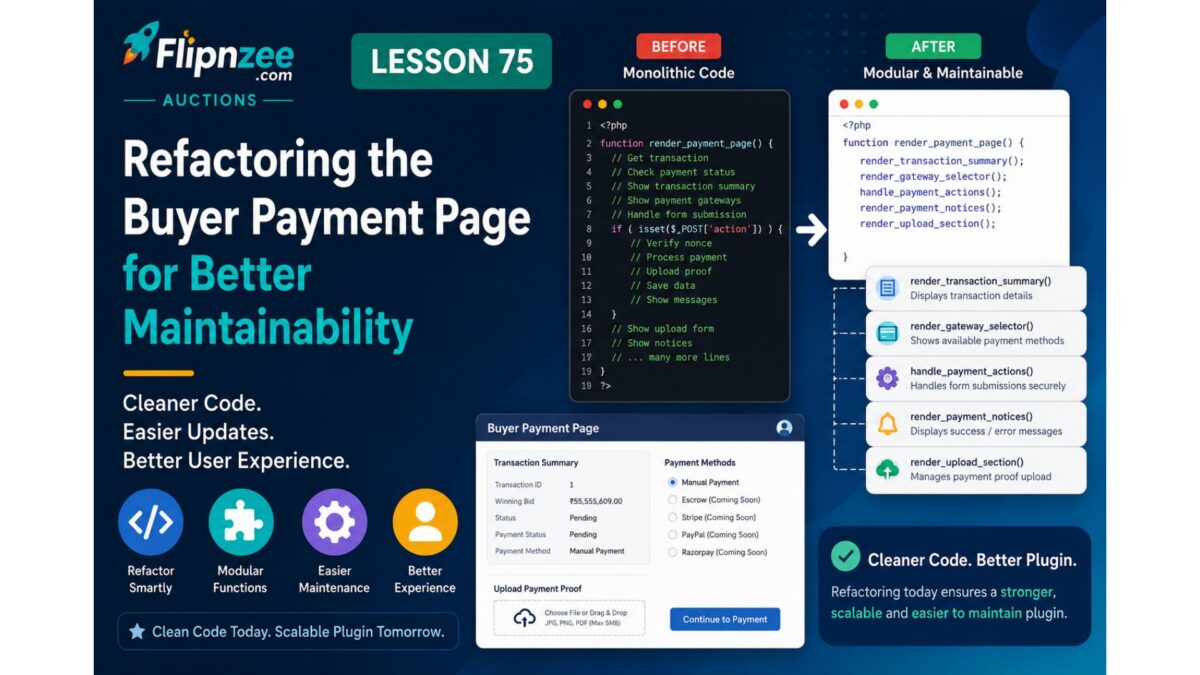
As new payment features were added in previous lessons, the class-payment-page.php file began taking on multiple responsibilities. It was loading transactions, processing form submissions, rendering payment instructions, displaying transaction summaries, and generating the payment gateway interface.
Before adding more complex features such as payment proof uploads, transaction status updates, and administrator verification, it became important to reorganize the code into smaller, reusable methods.
In this lesson, we refactor the Buyer Payment Page without changing its functionality. The goal is to improve readability, maintainability, and prepare the payment architecture for future enhancements.
Why Refactor?
Rather than allowing one method to grow indefinitely, we separate different responsibilities into dedicated helper methods.
Benefits include:
- Cleaner code
- Easier debugging
- Better readability
- Improved reusability
- Simpler future development
- Better alignment with object-oriented programming principles
What We Refactored
1. Transaction Summary
The payment summary table was moved into its own method:
private static function render_transaction_summary( $transaction )
This isolates all transaction display logic from the main rendering workflow.
2. Gateway Selection
The payment gateway form was extracted into:
private static function render_gateway_selector( $gateways )
This method now handles:
- Gateway radio buttons
- WordPress nonce
- Payment action buttons
3. Manual Payment Instructions
The manual payment instructions were extracted into:
private static function render_manual_payment( $transaction )
This keeps all manual payment presentation in one place and makes future enhancements (payment proof upload, bank details, etc.) much easier.
4. Cleaner Main Render Method
Instead of containing hundreds of lines of mixed HTML and PHP, the main render() method now delegates responsibilities to helper methods, making the overall flow much easier to understand.
Architecture Before Refactoring
render()

├── Transaction Summary
├── Manual Payment HTML
├── Gateway Form
├── Payment Instructions
├── Form Processing
└── Validation
Architecture After Refactoring
render()
│
├── Process Request
│
├── render_manual_payment()
│
├── render_transaction_summary()
│
└── render_gateway_selector()
This modular approach makes each method easier to read, test, and extend.
Files Modified
includes/class-payment-page.php
Skills Learned
During this lesson, we practiced:
- Refactoring legacy code
- Separating responsibilities
- Creating reusable helper methods
- Improving object-oriented design
- Preparing a codebase for future expansion
Outcome
Although this lesson did not introduce new user-facing functionality, it significantly improved the internal architecture of the payment system. The Buyer Payment Page is now modular, easier to maintain, and ready for upcoming features such as payment proof uploads, transaction status updates, administrator verification, and future payment gateway integrations.