
Lesson 85: Building a Robust Database Migration Engine for WordPress Plugins

Introduction
As WordPress plugins evolve, their database schema often needs to change. New columns, indexes, and even tables may be added as features are introduced. While WordPress provides the dbDelta() function to create and update database tables, real-world experience has shown that it is not always reliable for upgrading complex schemas across different hosting environments, PHP versions, and database servers.
During the previous lesson, while extending the Flipnzee Auctions payment system, extensive debugging revealed that the SQL definitions were valid, yet dbDelta() repeatedly generated invalid index upgrade statements when attempting to modify an existing table. Rather than continuing to rely on automatic schema parsing, this lesson introduces a dedicated database migration engine that performs controlled, version-based upgrades.
This approach follows the design philosophy used by many mature WordPress plugins and provides much greater reliability for long-term maintenance.
Objectives
By the end of this lesson we will:
- Create a database version management system.
- Store the installed database version.
- Detect plugin upgrades automatically.
- Execute database migrations only when required.
- Check whether columns already exist.
- Check whether indexes already exist.
- Safely execute
ALTER TABLEstatements. - Prevent duplicate database modifications.
- Prepare the plugin for future schema upgrades.
Why Database Migrations Matter
Using only dbDelta() works well when a plugin is first installed, but upgrading an existing database becomes increasingly difficult as more features are added.
A migration system offers several advantages:
- predictable upgrades
- version tracking
- improved compatibility
- safer production deployments
- easier debugging
- rollback-friendly architecture
Instead of recreating entire table definitions during every plugin activation, migrations apply only the changes required for the installed version.
Proposed Architecture
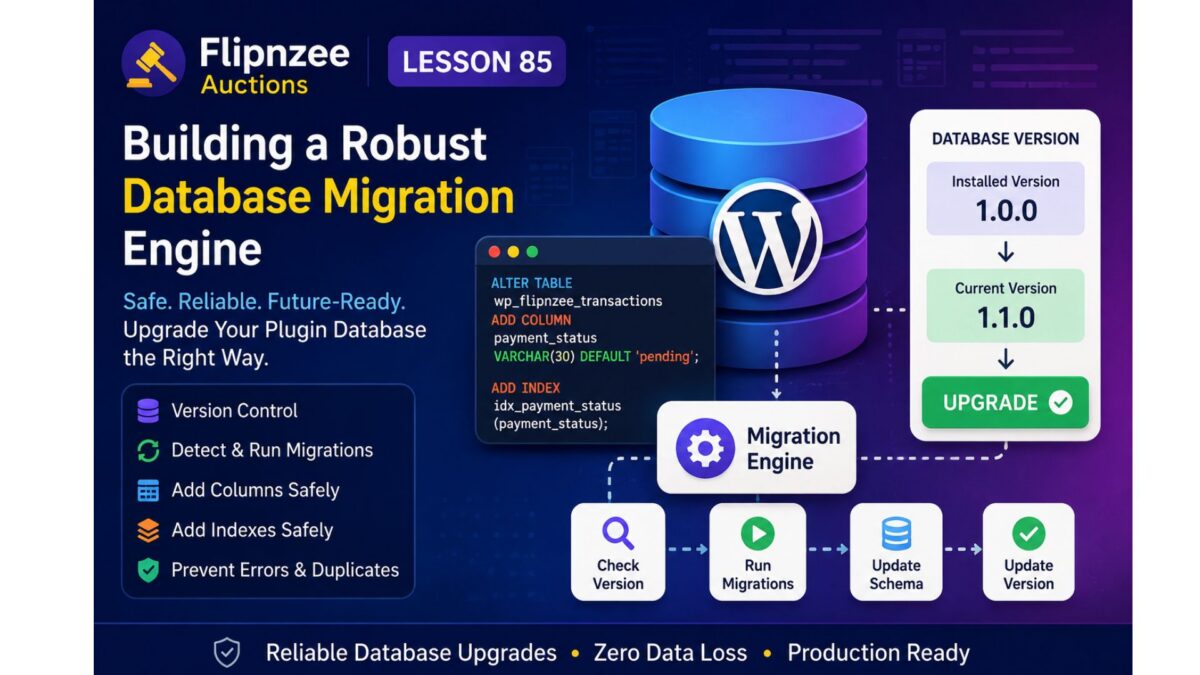
The migration engine will consist of four main components.
1. Database Version Constant
define( 'FLIPNZEE_DB_VERSION', '1.1.0' );
2. Stored Database Version
get_option( 'flipnzee_db_version' );
3. Migration Runner
Plugin Activated
        │
        ▼
Read Installed Database Version
        │
        ▼
Compare With Current Version
        │
        ▼
Run Required Migration(s)
        │
        ▼
Update Stored Version
4. Individual Migration Methods
Examples include:
migrate_to_1_1_0()

migrate_to_1_2_0()

migrate_to_1_3_0()
Each migration performs only the changes required for that specific release.
Column Upgrade Strategy
Before adding a column:
SHOW COLUMNS
If the column does not exist:
ALTER TABLE
ADD COLUMN ...
Otherwise:
Skip
This prevents duplicate column errors.
Index Upgrade Strategy
Instead of relying on dbDelta():
SHOW INDEX
If the index is missing:
ALTER TABLE
ADD INDEX
Otherwise:
Skip
This avoids parser-related upgrade issues.
Benefits
After implementing the migration engine, Flipnzee Auctions will gain:
- reliable upgrades
- production-safe database changes
- incremental schema evolution
- simpler debugging
- compatibility with existing installations
- cleaner activation logic
- easier future development
Files Expected to Change
During implementation we expect to work primarily with:
includes/class-database.php
Potentially also:
flipnzee-auctions.php
to initialise the migration process during activation.
Skills Learned
This lesson introduces several professional WordPress development concepts:
- semantic database versioning
- migration architecture
- schema evolution
- defensive database programming
- production-safe plugin upgrades
- backward compatibility
Expected Outcome
By the end of this lesson, Flipnzee Auctions will no longer depend entirely on dbDelta() for schema upgrades.
Instead, the plugin will include a dedicated migration engine capable of safely upgrading existing installations while preserving data and supporting future releases.
This establishes a solid foundation for upcoming lessons involving payment verification, escrow workflows, notifications, reporting, and additional marketplace features without risking database inconsistencies.