
Lesson 121: Building an Escrow Provider Engine for Flipnzee Auctions

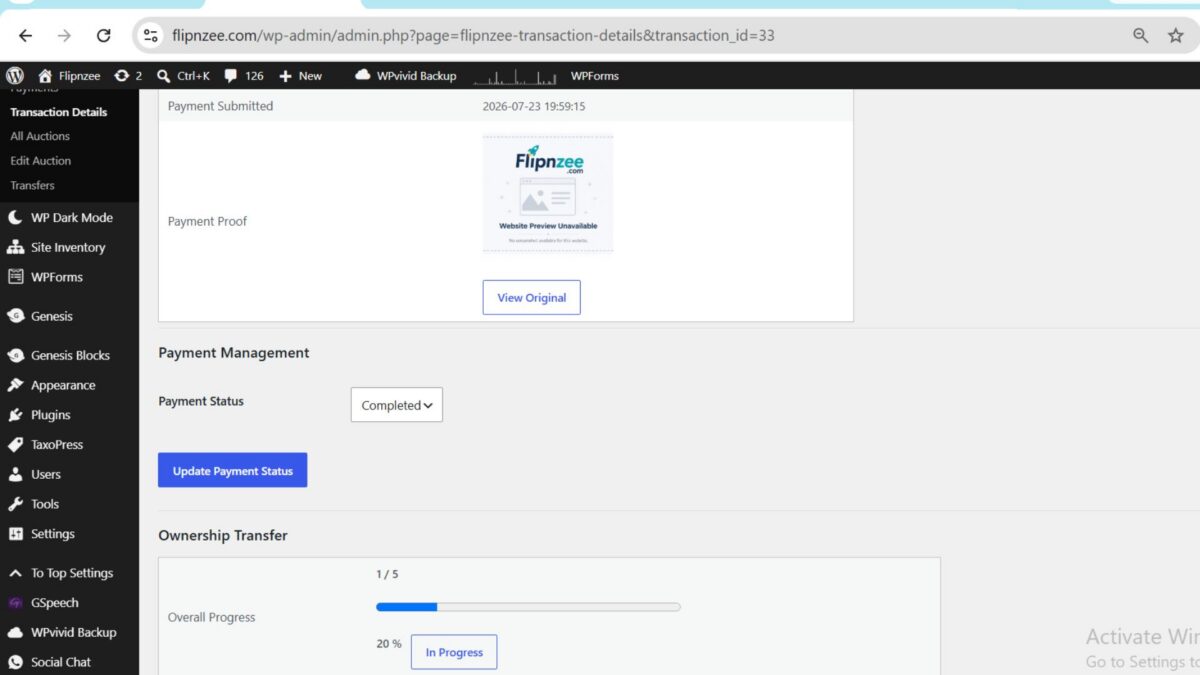
As the Flipnzee Auctions plugin matures, the payment workflow is becoming more structured and event-driven. In previous lessons, payment completion triggered the transaction lifecycle, and ownership transfer records were automatically created.
In this lesson, the next major component is introduced: an Escrow Provider Engine.
Although this lesson uses a simulated provider instead of connecting to a real escrow service, it establishes the architecture required for integrating providers such as Escrow.com in the future.
Why an Escrow Provider?
High-value website and domain transactions require trust between buyers and sellers.
Rather than immediately transferring funds or ownership, an escrow service acts as a trusted intermediary by:
- Holding buyer funds securely
- Waiting until transfer conditions are satisfied
- Releasing funds to the seller after successful delivery
Instead of hardcoding a specific provider throughout the plugin, Flipnzee Auctions now introduces an abstraction layer dedicated to escrow providers.
Objectives
By the end of this lesson the plugin will:
- create an escrow transaction automatically after payment completion
- generate a unique escrow reference
- isolate escrow logic into its own provider class
- keep transaction lifecycle independent from any specific provider
- prepare the plugin for future Escrow.com API integration
Creating the Escrow Provider
A new provider class was introduced:
includes/
└── class-escrow-provider.php
The provider is intentionally lightweight.
Its responsibility is simply to manage escrow-related operations without affecting the transaction manager or ownership transfer logic.
Initialization is handled through:
Flipnzee_Escrow_Provider::init();
This keeps provider-specific functionality separated from the rest of the plugin.
Simulating Escrow Creation
Rather than connecting to a live API, the provider currently generates an internal escrow reference.
Example:
ESCROW-20260723144534-33
This combines:
- current UTC timestamp
- transaction ID
The resulting reference behaves similarly to what an external escrow provider would return after successfully opening an escrow transaction.
Connecting Escrow to the Transaction Lifecycle
Previously, payment completion created an ownership transfer record.
The workflow has now been extended.
Payment Completed
        │
        ▼
Transaction Lifecycle
        │
        ├────────► Create Ownership Transfer
        │
        ▼
Create Escrow Transaction
        │
        ▼
Generate Escrow Reference
This means escrow creation becomes an automatic consequence of payment completion.
No administrator intervention is required.
Event-Driven Architecture
One of the biggest improvements in this lesson is reinforcing an event-driven design.
Instead of directly calling escrow code from the payment page, the plugin continues using WordPress actions.
Payment Updated
        │
        ▼
flipnzee_payment_completed
        │
        ▼
Transaction Lifecycle Manager
        │
        ├────────► Transfer Manager
        │
        └────────► Escrow Provider
This approach offers several advantages:
- lower coupling
- easier testing
- simpler future extensions
- better maintainability
Why This Design Matters
Imagine replacing the simulated provider with:
- Escrow.com
- Stripe Escrow (if available)
- custom enterprise escrow
- another regional escrow service
The transaction lifecycle would remain unchanged.
Only the provider implementation would need to change.
That separation makes the architecture considerably more flexible.
Debugging the Workflow
During implementation, extensive logging was added to verify each stage of the lifecycle.
The logs confirmed:
Payment status updated

↓

Payment completed action fired

↓

Transaction lifecycle started

↓

Ownership transfer created

↓

Escrow provider invoked

↓

Escrow reference generated
This confirmed that the entire workflow executes exactly as intended.
After validation, temporary debugging hooks were removed while retaining useful lifecycle logging for development.
Current Escrow Flow
The payment pipeline now behaves as follows:
Buyer submits payment
        │
        ▼
Administrator verifies payment
        │
        ▼
Payment Completed
        │
        ▼
Transaction Lifecycle Manager
        │
        ├────────► Ownership Transfer
        │
        └────────► Escrow Provider
                        │
                        ▼
              Escrow Reference Created
This creates a clean foundation for integrating real external services.
What We Accomplished
In this lesson we successfully:
- created the Escrow Provider class
- initialized the provider during plugin bootstrap
- integrated escrow creation into the transaction lifecycle
- generated simulated escrow references
- maintained loose coupling through WordPress actions
- validated the complete workflow using event-driven architecture
- prepared the plugin for real escrow provider integration
Looking Ahead
The current provider generates simulated escrow transactions.
In the next lessons, the plugin will evolve further by storing provider information in the database, tracking escrow status, and eventually communicating with real escrow APIs.
By introducing the provider abstraction now, future integrations can be added without restructuring the payment lifecycle.
This is one of the key architectural milestones in transforming Flipnzee Auctions from a simple auction plugin into a professional platform for buying and selling websites, domains, and digital assets.
https://github.com/SplendidDigital/flipnzee-auctions/releases/tag/lesson-121-stable